Bona Obiri-Yeboah on Poetry, Diaspora, and Non-Aligned Books
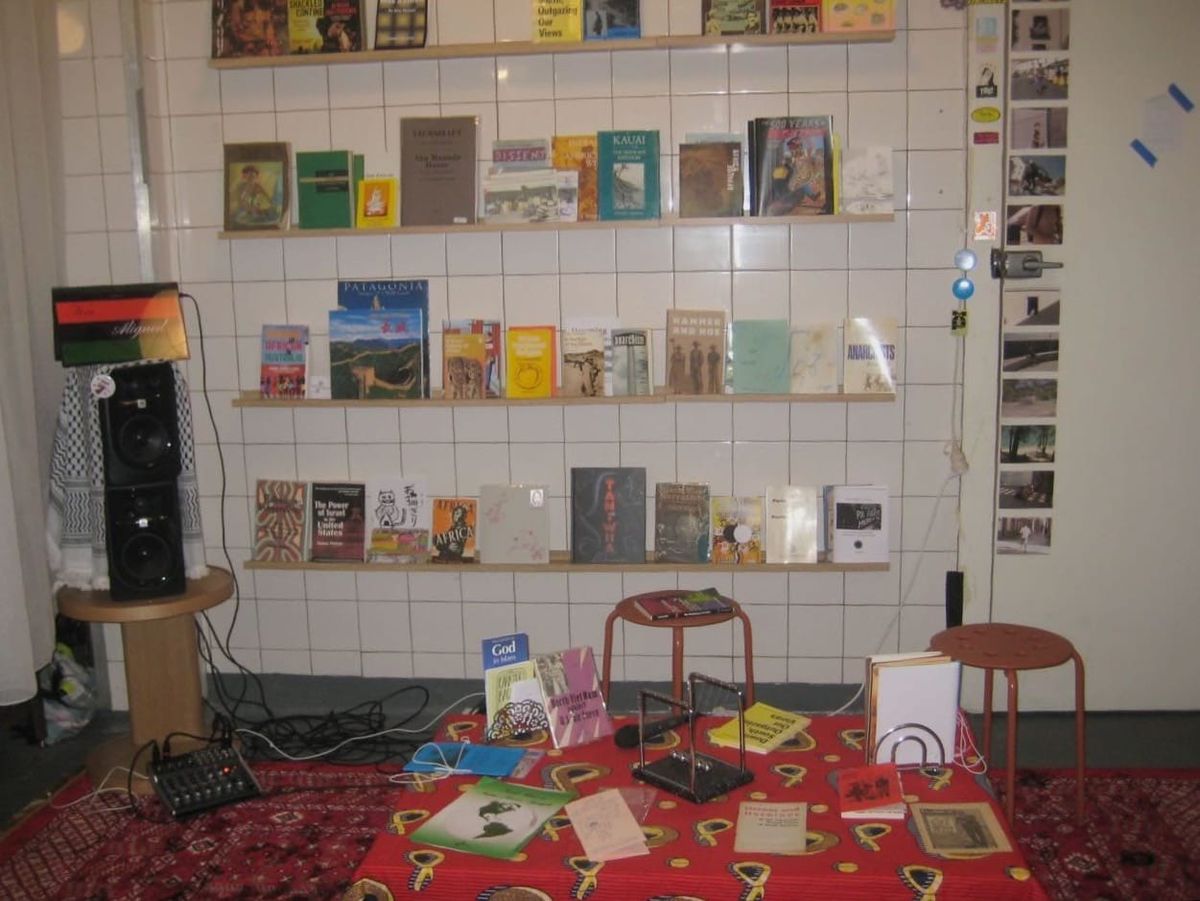
In 2025, independent publishers, art bookshops, and book artists from across Indonesia gathered in Jakarta for Press Print Party, the city’s art book fair.¹ As soon as the fair ended, Cahyati Press,² a publisher based far away in Bali, organized two events in central Jakarta, including a poetry reading for a newly published chapbook and book launches by several authors.
Events were packed. The importance Indonesian creators place on self-publishing and the communities surrounding it was impossible to miss. In 2026, Cahyati Press and Bona Obiri-Yeboah—the author of its poetry chapbook Ruminations and the subject of this interview—continued on to Australia to take part in several art book fairs.
Bona Obiri-Yeboah is a poet based in Australia, whose work is shaped by his Ghanaian heritage and queer identity. Rewind to 2024: he sent the manuscript of his poetry collection to several publishers he admired, and that was how his connection with Indonesia began. Together with Cahyati Press, he travelled through cities and islands across the country, later inspired him to return to Australia and open his own bookshop, Non-Aligned Books.
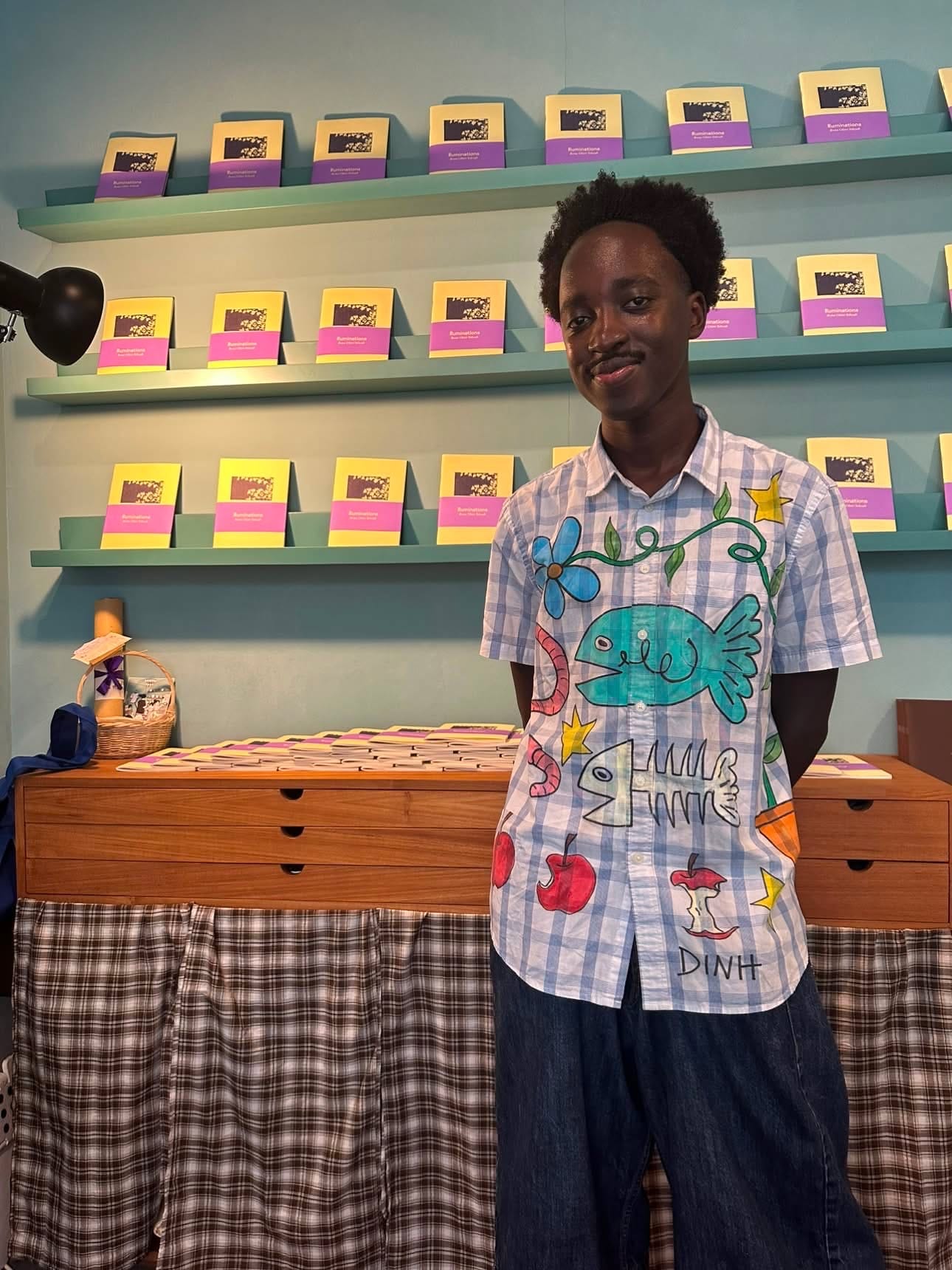
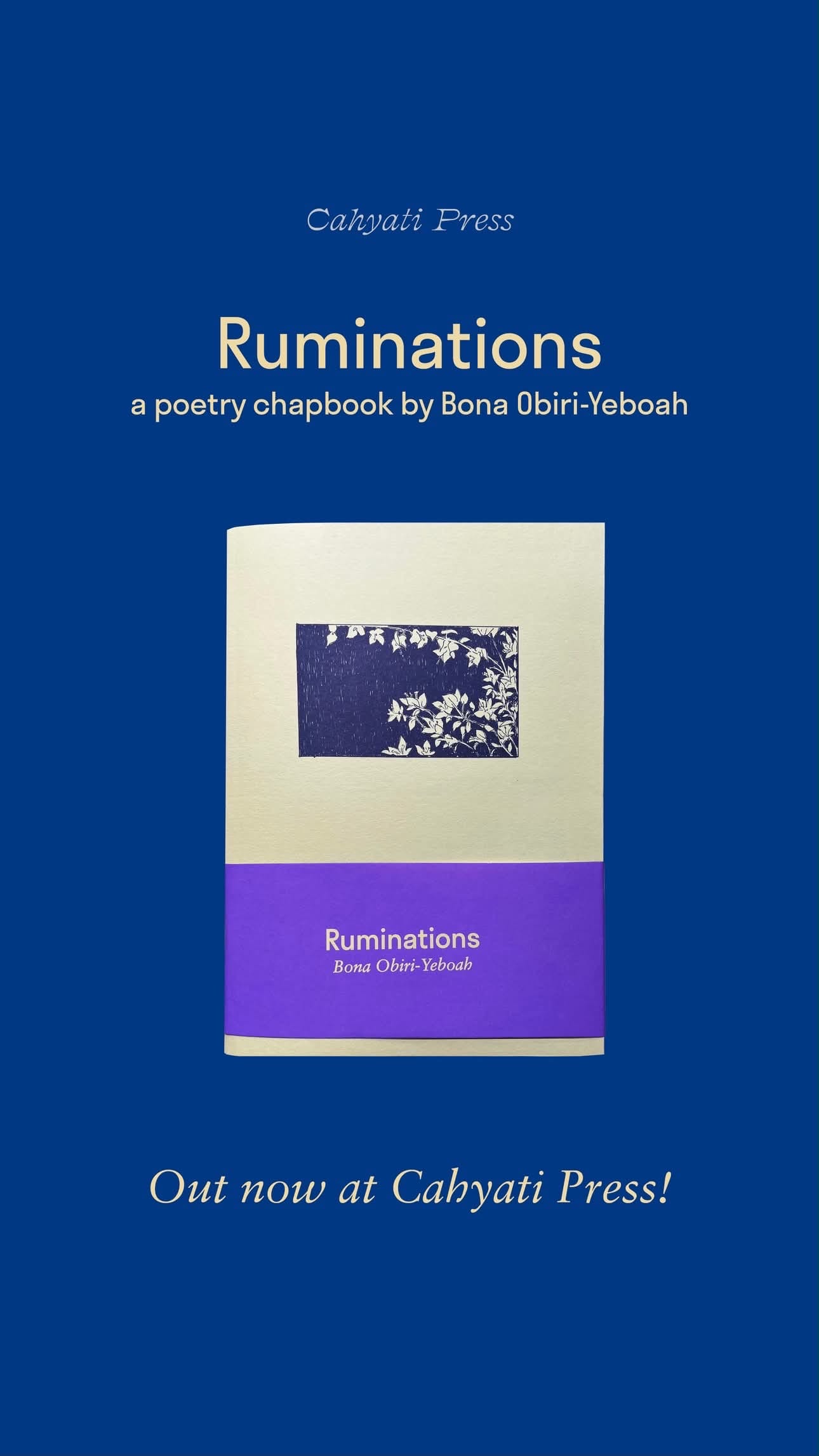
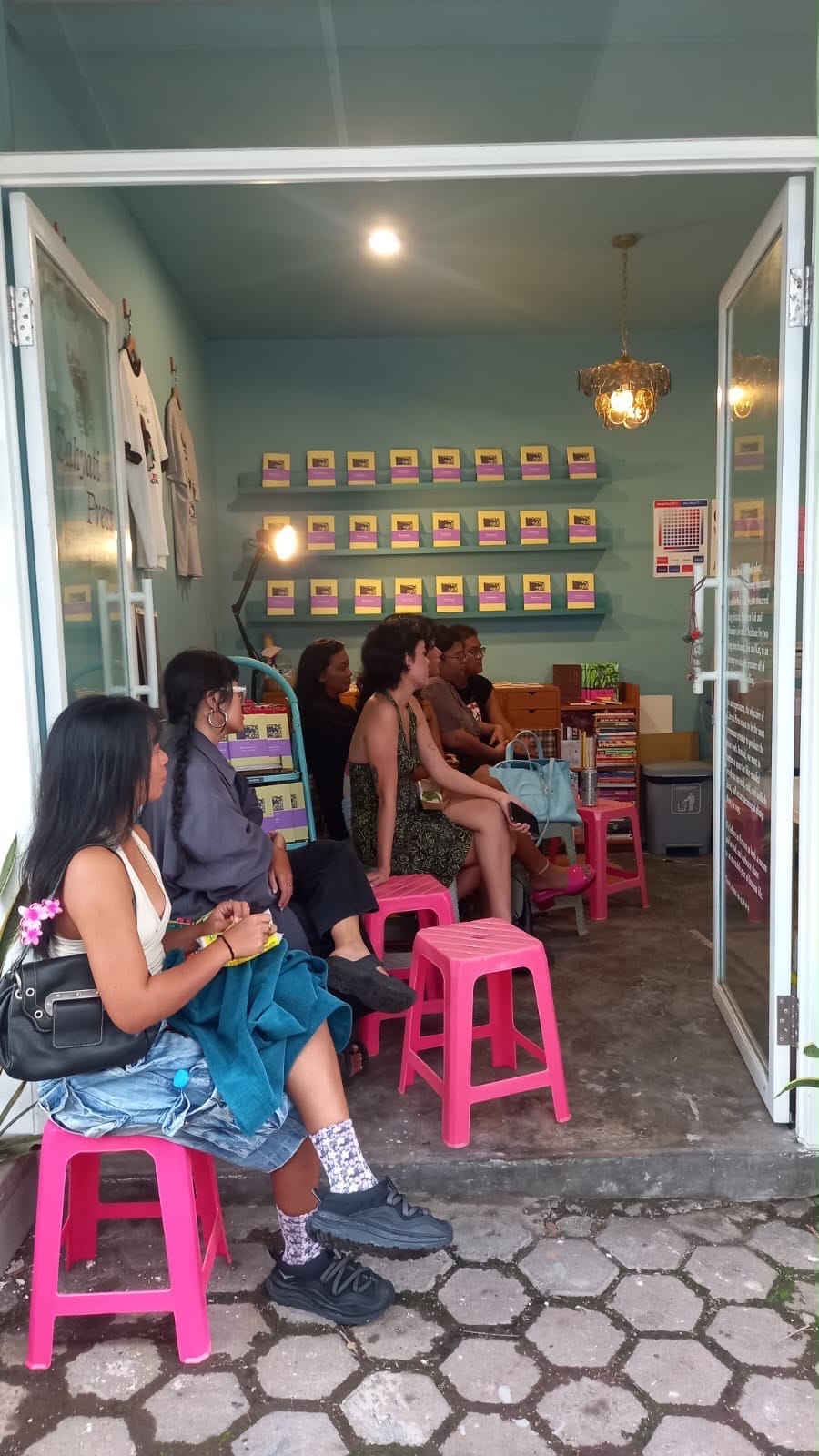
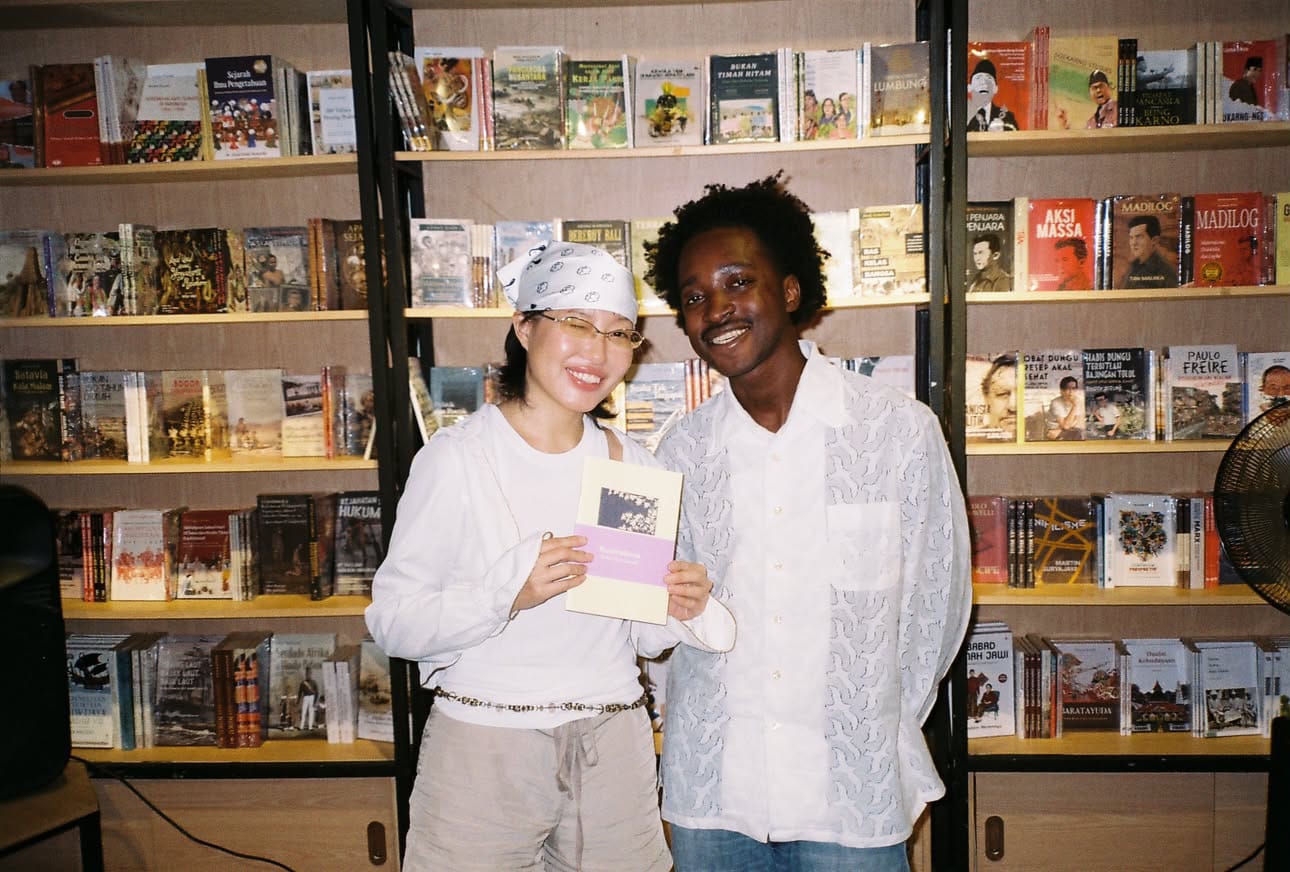
Bona Obiri-Yeboah at the launch and poetry reading for his new poetry chapbook Ruminations at Cahyati Press, Bali, 2024.
Bona and I met at Press Print Party because our booths were next to each other. It is also entirely possible that I only found an excuse to talk to him because he showed up every day in a different, amusing T-shirt. After we both returned home, Indonesia continued to exert its strange and powerful pull on us—something that, like durian, seemed only to grow stronger with time. That lingering connection eventually led to this interview.
Unfortunately, just as this interview is being published, Non-Aligned Books has announced that it will temporarily close. The commercial use of its physical premises was found to involve regulatory issues that, according to the bookstore, had been deliberately concealed when the lease was signed, making it impossible for the shop to continue operating there.
“But we remain awash with hope for the future. ...The physical space is only one dimension of Non-Aligned Books. ...Non-Aligned Books is the concept, the community, the collection and our conviction that make it possible.”
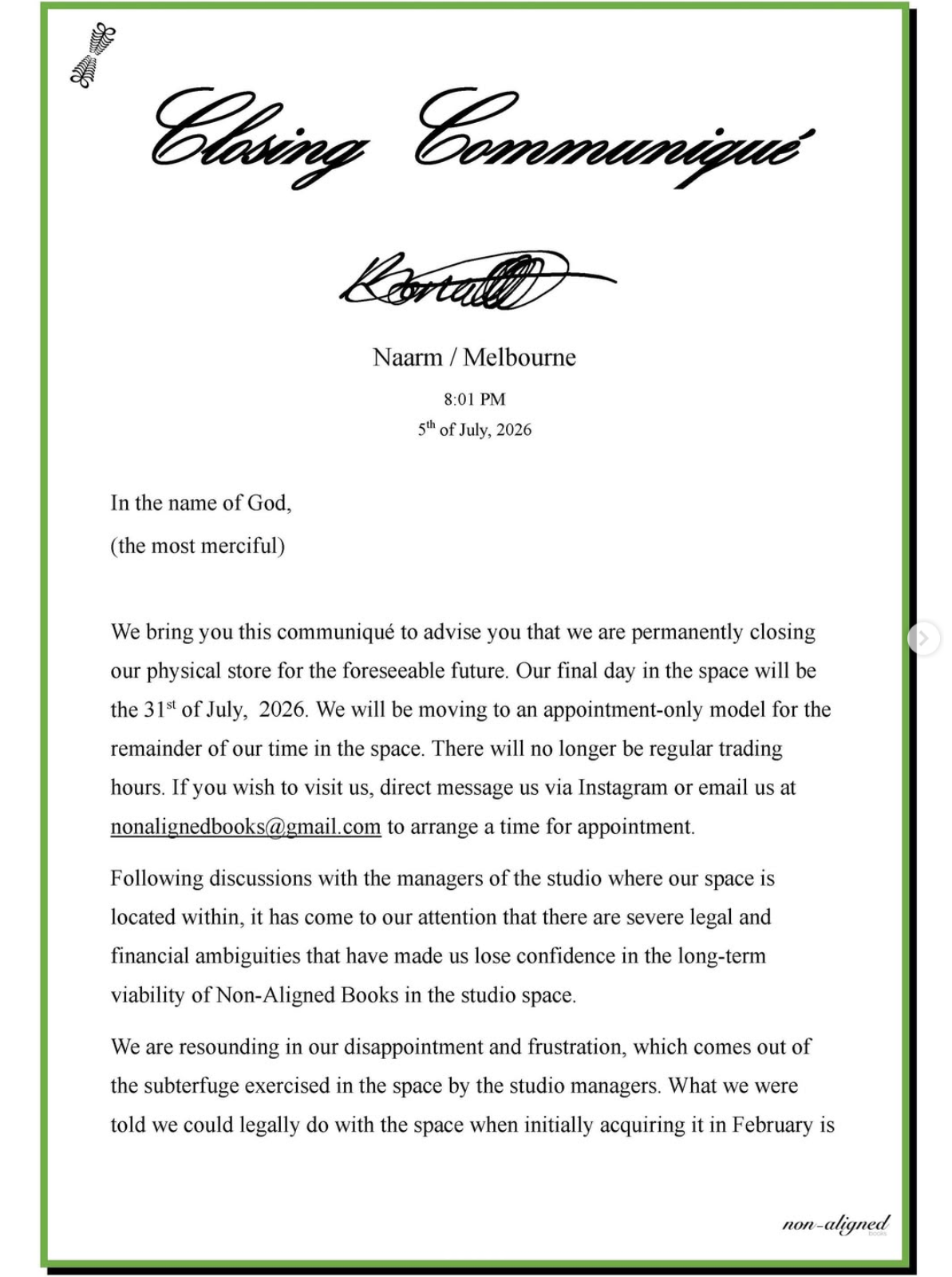
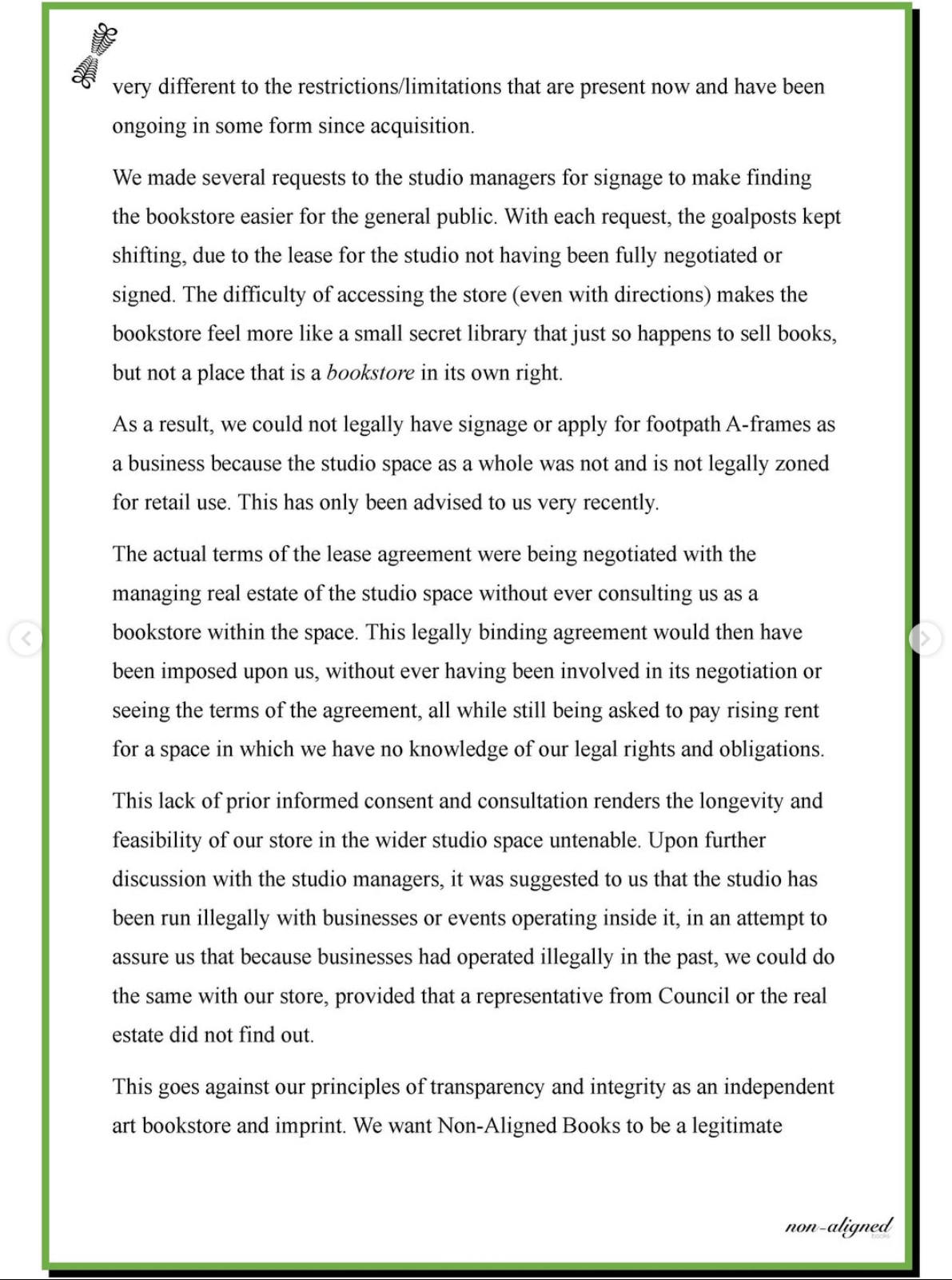
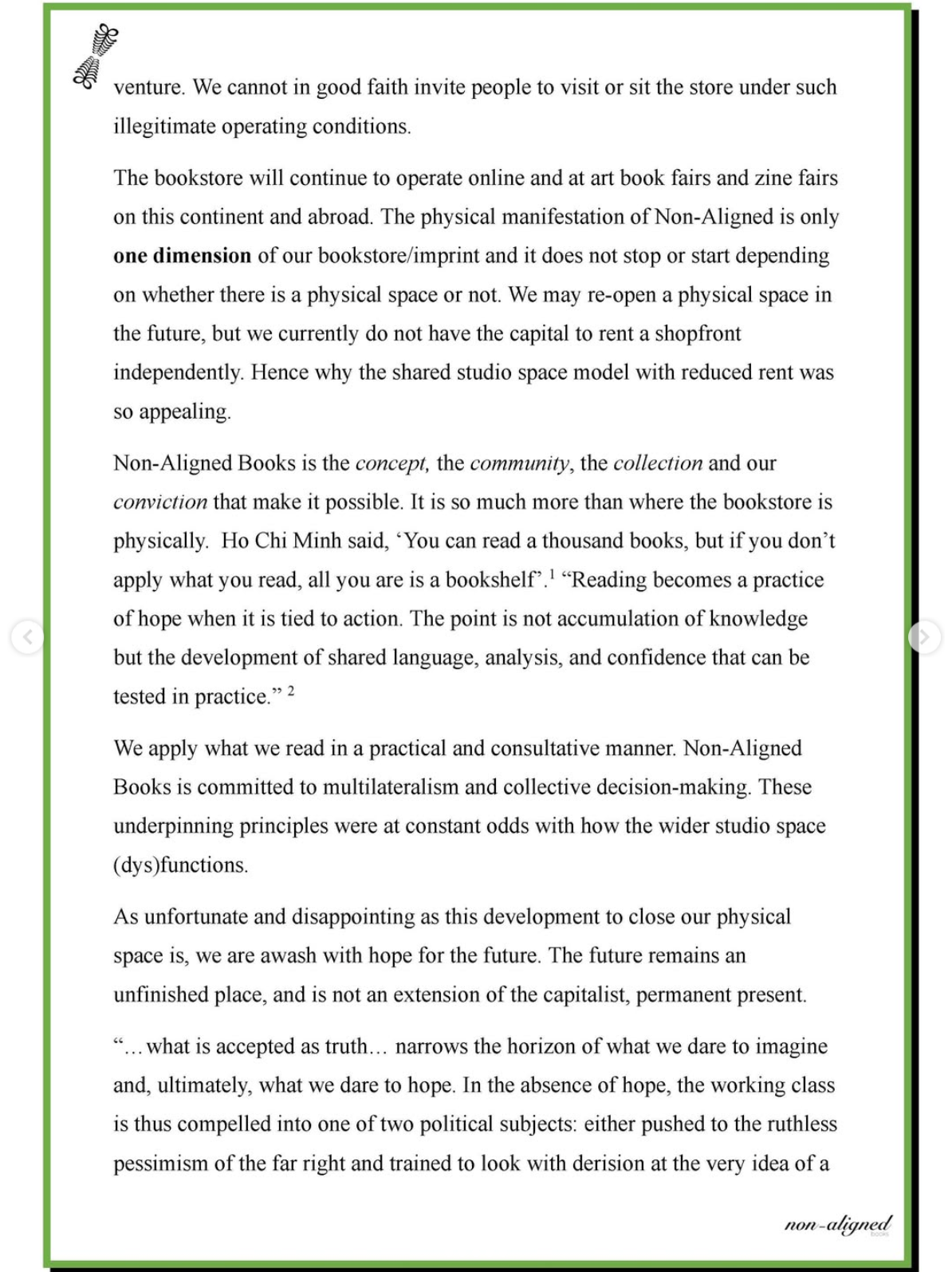
The first three pages of the bookstore’s closure statement, posted on its social media.³
The “4C” statement issued as the shop prepares to close feels like a shot in the arm—not only for independent publishing practitioners, but for all of us trying to survive within the unpredictable terrain of the arts while holding on to some measure of hope.
In this interview, we will glimpse Bona Obiri-Yeboah’s teenage years and learn how his diasporic identity, education, and publishing journey through Indonesia shaped his decision to open a physical bookshop at this particular moment. Here come to_ press’s 10 (or perhaps 100,000) questions for the endlessly curious.
Q1. Hi, Bona! Tell us a little more about yourself and Non-Aligned Books! What kind of space are you building, and what do you hope it can become?
Bona:Hello!
My name is Bona Obiri-Yeboah, I am the founder, executive director and chief editor of Non-Aligned Books. Non-Aligned Books is an independent art bookstore in Naarm/Melbourne specialising in printed matter on Africa, its Diaspora, class struggle and the Global South.
I hold a Bachelor of Arts in International Relations & Japanese from The University of Queensland. The gaps and agendas that I saw in my International Relations courses continue to inspire my own written work and now, the curation of Non-Aligned Books.
I am also the author of Ruminations, a debut chapbook published by Cahyati Press in 2024. Ruminations is a collection of poems meditating on romance, (un)belonging and on moving through the fragmented fever-dream of black life in the colony.
Non-Aligned Books takes its name from the Non-Aligned Movement, a movement and the second-largest association of countries that came out of the first large scale Afro-Asian conference in 1955.
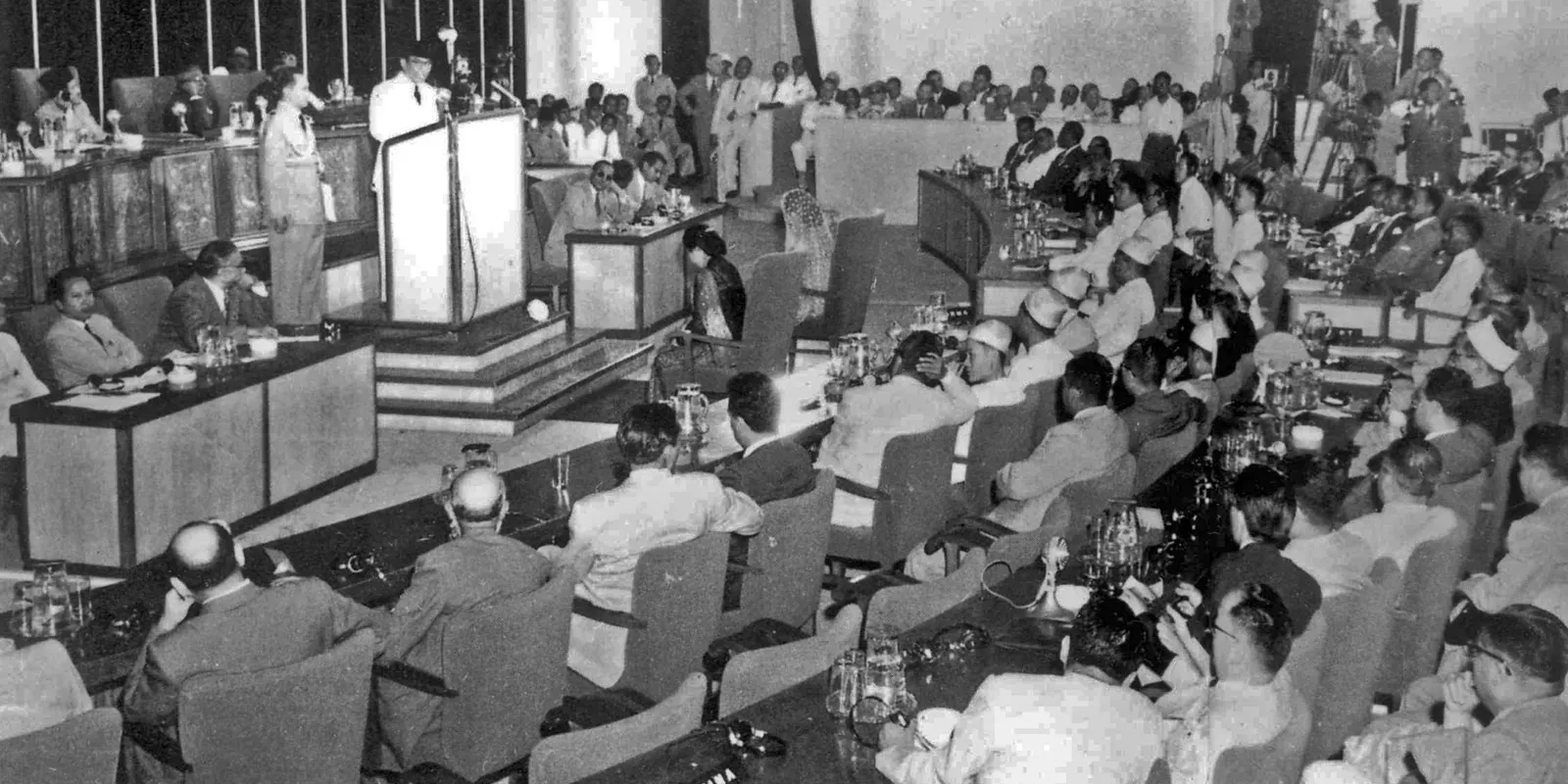
This conference is also popularly known as the Bandung Conference, as it was held in Bandung, Indonesia. Non-Aligned Books seeks to continue this history of Afro-Asian solidarity, and as you shall soon read, the influence of Indonesia for Non-Aligned is not purely historical, but also contemporary.
I am building a space for cross-pollination and solidarity between different communities in Naarm/Melbourne. I believe that solidarity is not just a concept, but it is something that you do, live and continually practice. Solidarity exists at its strongest when we are together physically, and when people can learn the struggles and histories they share and support each other because of that.
I also wanted to create a space where African people can read themselves into the world. There is no dedicated bookstore here for African literature, so it was important for me to make one, because I believe in the power of our stories.
I hope to encourage more people to read and educate themselves about Africa, its Diaspora, class struggle and the Global South.⁴
From a Zine to a Bookshop
Part 2: Q2~Q4
Q2. After publishing Rumination in 2024, you spent a significant amount of time travelling and sharing your work. You've mentioned that your experiences in Indonesia had a strong influence on you and even played a role in inspiring Non-Aligned Books. Could you tell us about that journey, how the idea for the bookstore emerged, and why a bookstore felt like the right form for this moment in your life?
Without bearing witness to the commitment to DIY publishing in Indonesia, we would not have been able to envision the true effectiveness and feasibility of independent publishing.
Bona:It was deeply inspiring to see research collectives and bookstores like Kunci, Zine Zan Zun, TOS! Kecil, Hyphen—, Graphic Handler, Cahyati Press, Binatang Press and more express their stories in print.⁵ Further, without this exposure we would have not seen the value in telling our own stories as Africans living in Australia with our own hands and resources.
As a result, we came back to Australia and decided it was time for Non-Aligned Books to formalise the self-publishing we have been doing over the past five years. This process of formalising publications is grounded in Community and manifests in reciprocity. Formalising our own publications invites other Africans living in Australia to draw out the inherent value and cultural confidence in their stories.
Q3. The publications you collect span independent publishing, cultural criticism, anti-colonial thought, and voices from different regions and communities. Can you tell us about your journey as a bookstore curator? How did you begin collecting these publications, and are there any particular encounters, books, or stories that shaped the way you build your collection today?
Bona:My journey as a bookstore curator officially began this year at the end of January. However, my passion for curating books extends much beyond that, most likely to when I was a teenager. Many public things first begin in the home. My book collection was no different. As a teenager I kept a small, private collection of literature from some of my favourite black & queer authors.
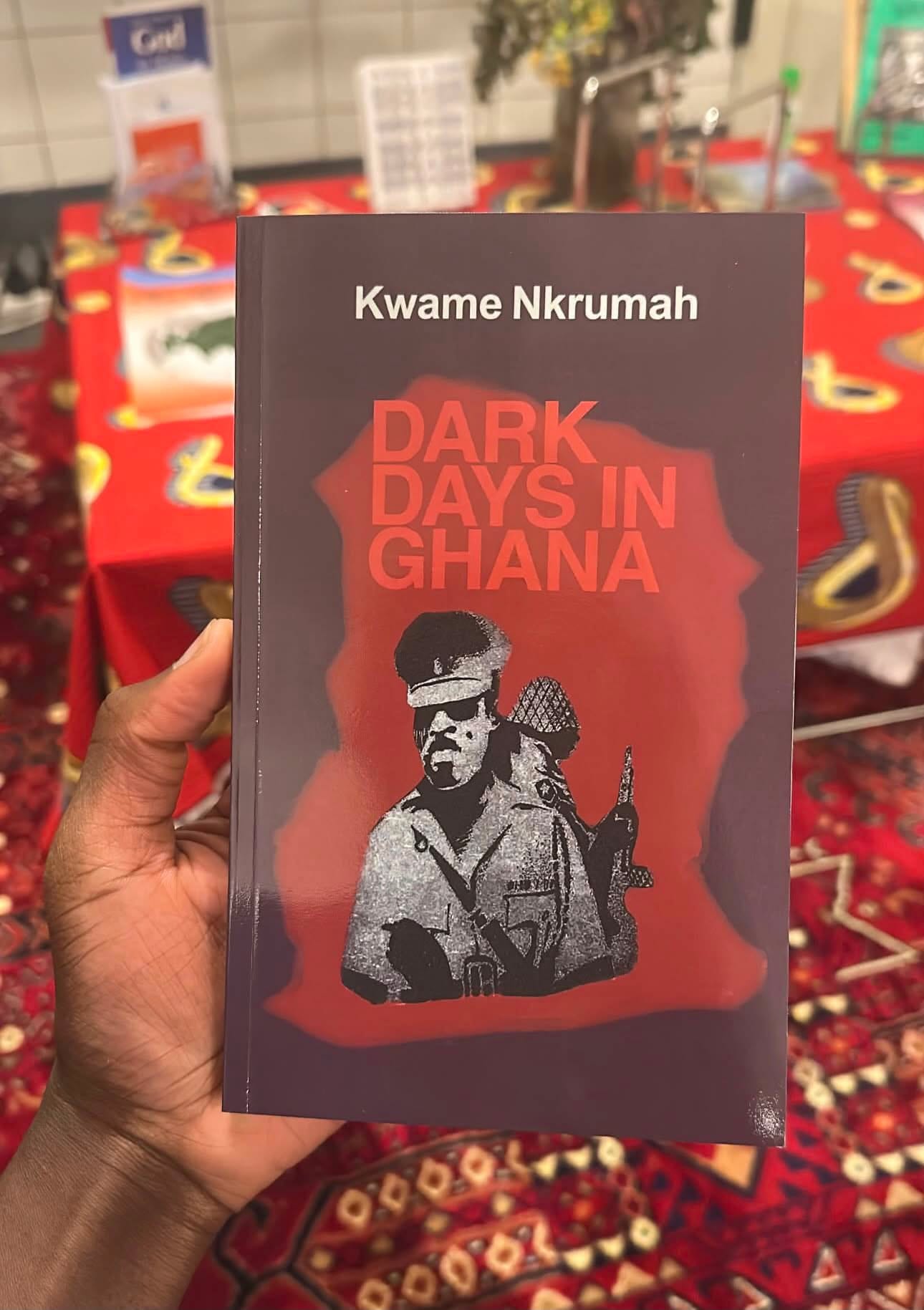
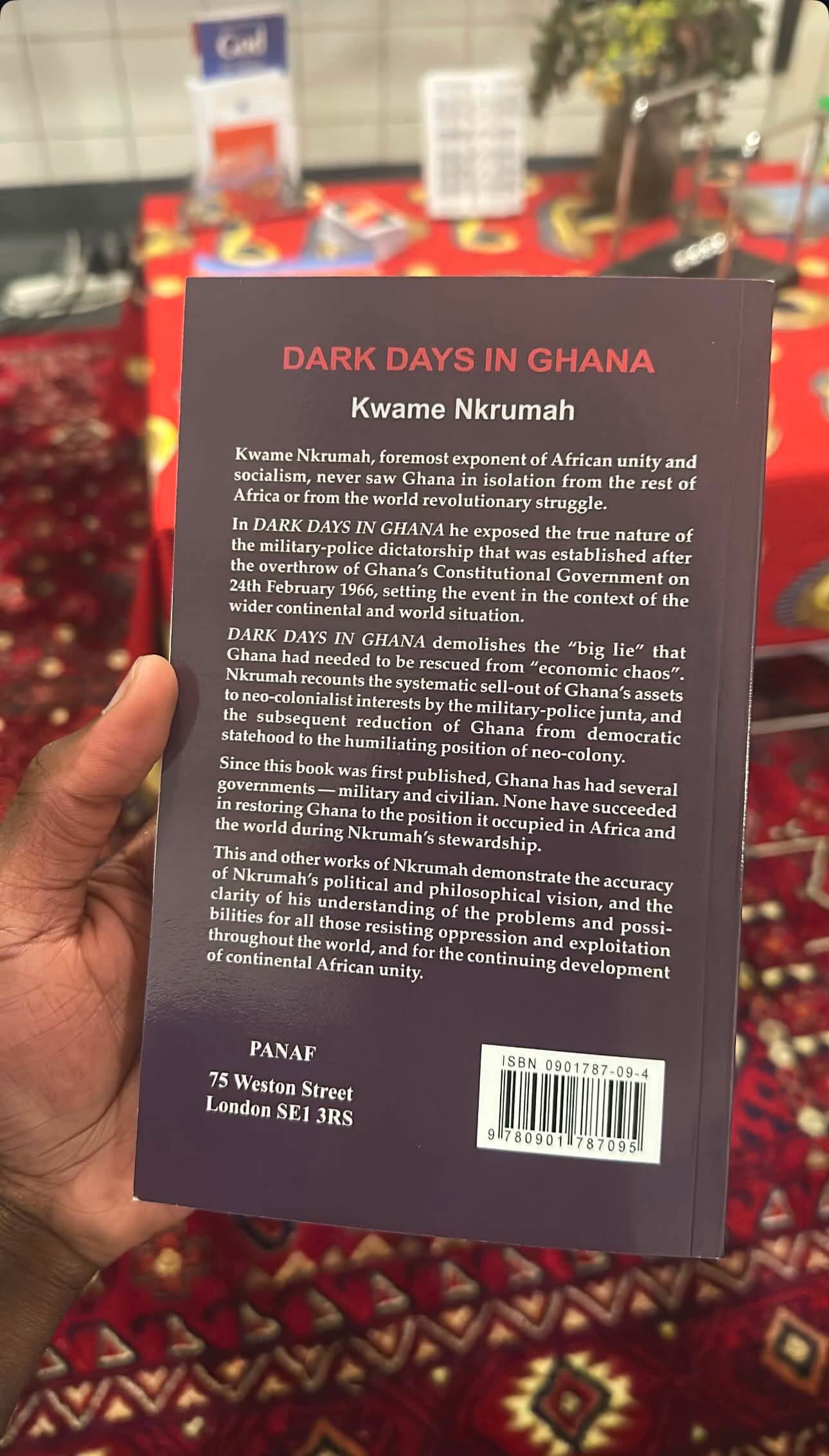
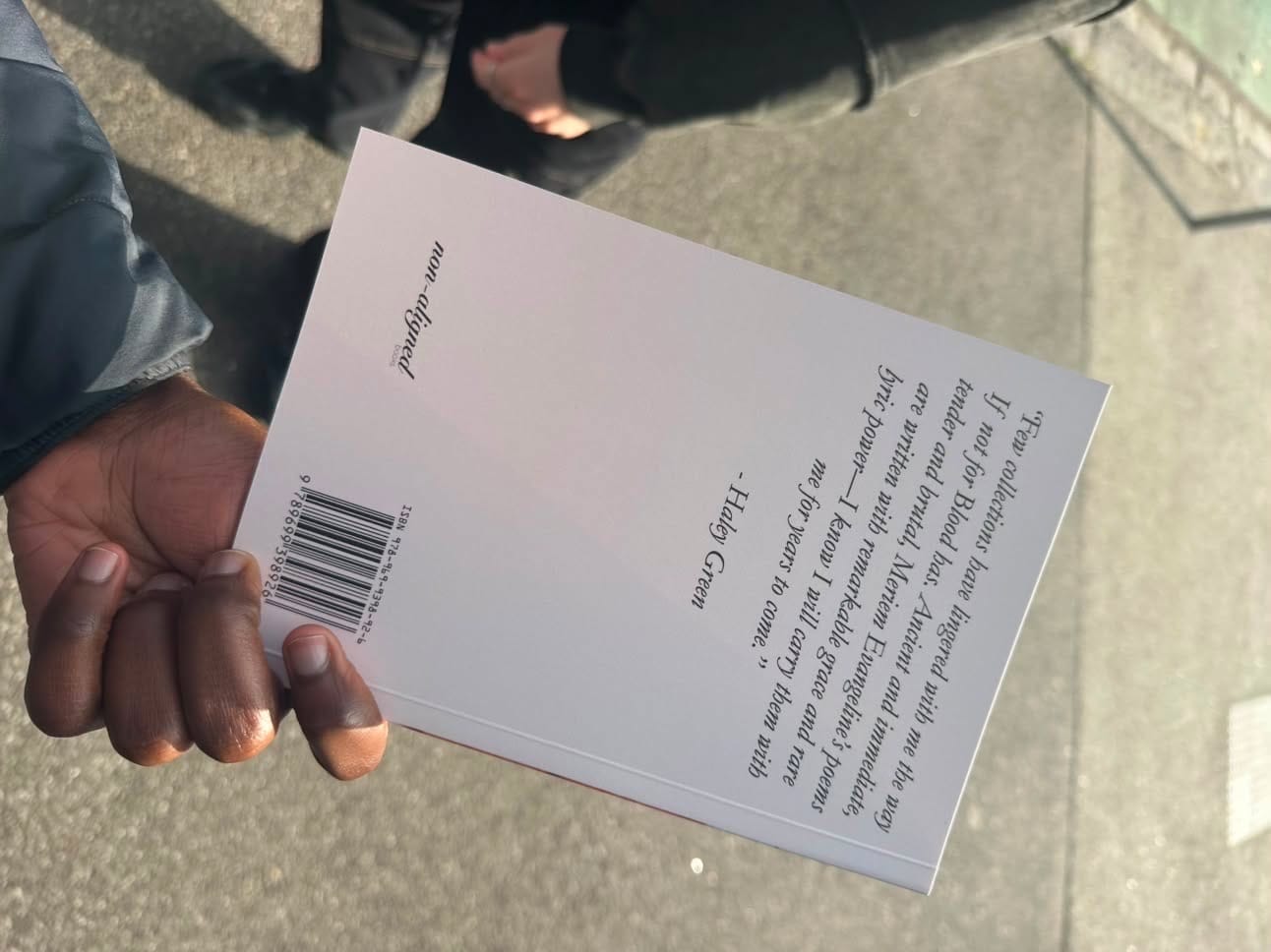
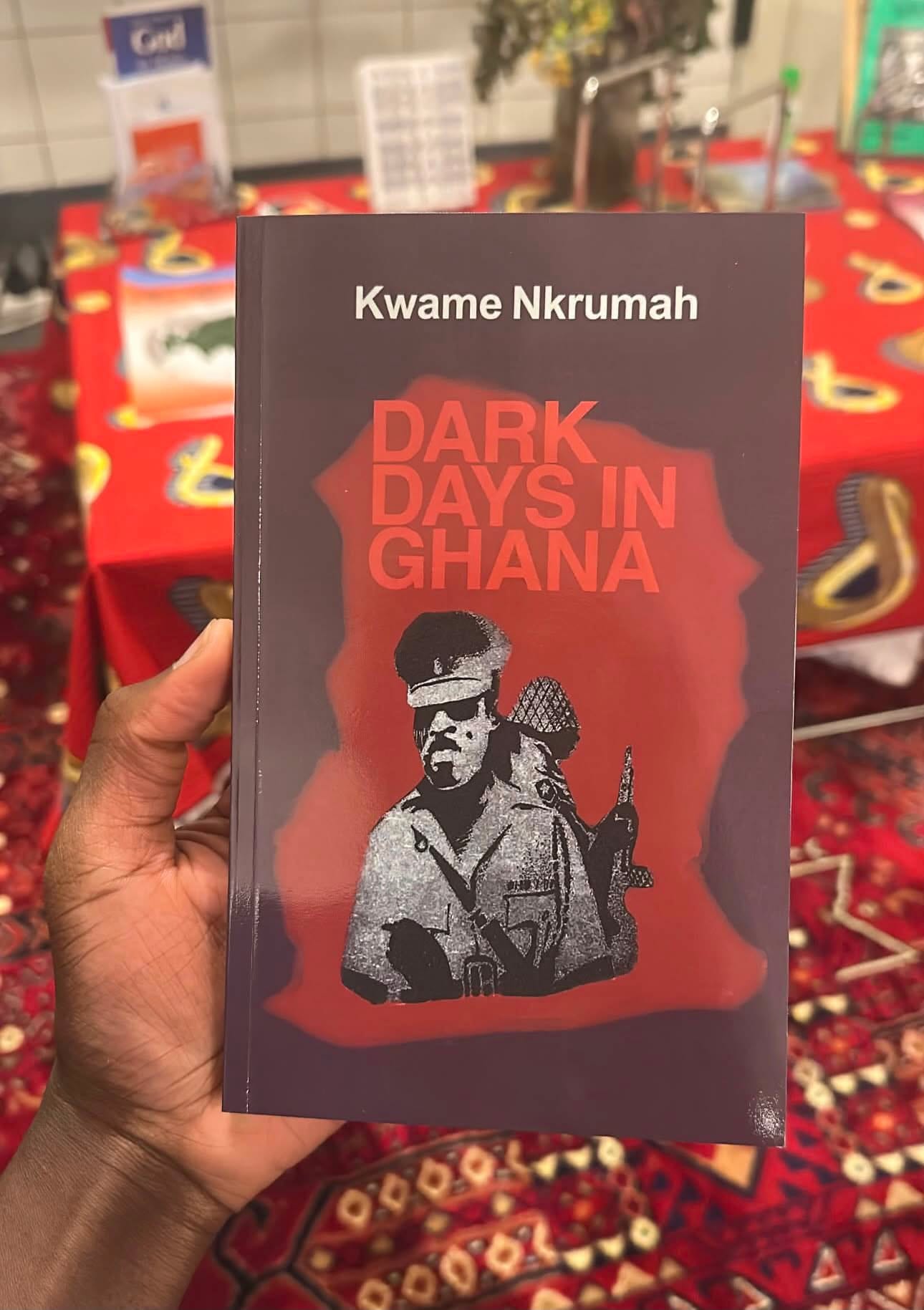
Dark Days in Ghana, a political work published in 1968 by Ghana’s first president, Kwame Nkrumah. The book reflects on Ghana following the 1966 coup and critiques military rule and neocolonialism from a Pan-Africanist perspective. From the collection of Non-Aligned Books, 2026.
My parents knew about the black authors’ books I had but did not know I had books by gay writers. I had not come out to them as gay at that point, so I saw my book collection at home as a small form of resistance.
A resistance against living in the outer-suburbs in a nuclear family. Resistance against the ways I was taught that I had to perform in order to be successful. My home collection was also a resistance against the prevailing idea that African people are outside of knowledge or of history.
It was always and still is (sometimes) a ‘surprise’ to people in this colony that my English ‘is so good’, something that many people from migrant backgrounds may experience in Australia and other Western countries where the main language spoken is English. So for me, reading allowed resistance…and allowed for transcendence many of these limitations, concepts and prejudices in my own small way.
It was out of this that my desire for books and their innumerable genres deepened. Gradually, the process of collecting was more than just about possession, but it was resistance. Fast forward around a decade. After self-publishing my ongoing so-called “Australia” zine project and publishing Ruminations with Cahyati Press, I began to find myself involved in art book fairs, zine fairs and so on.
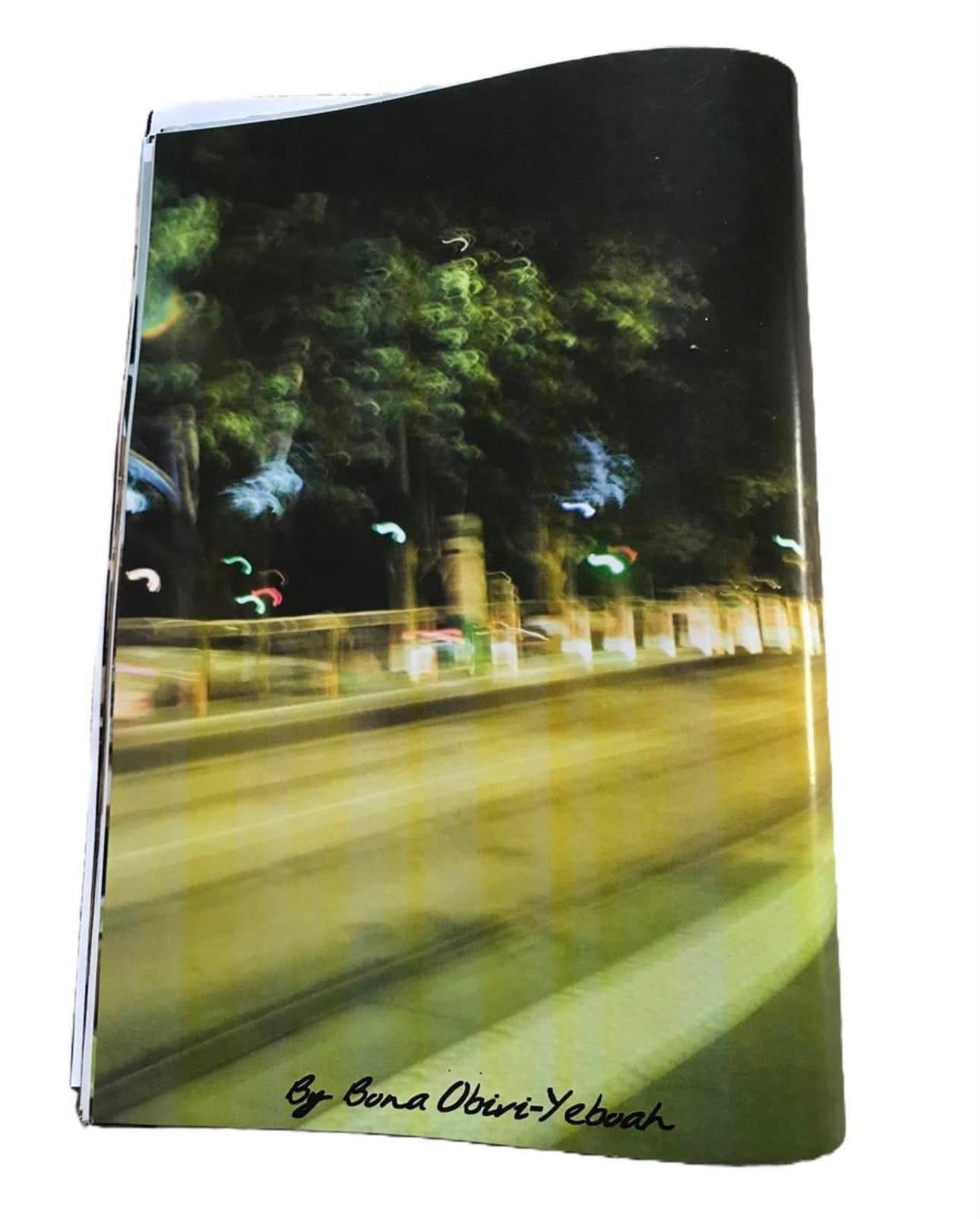
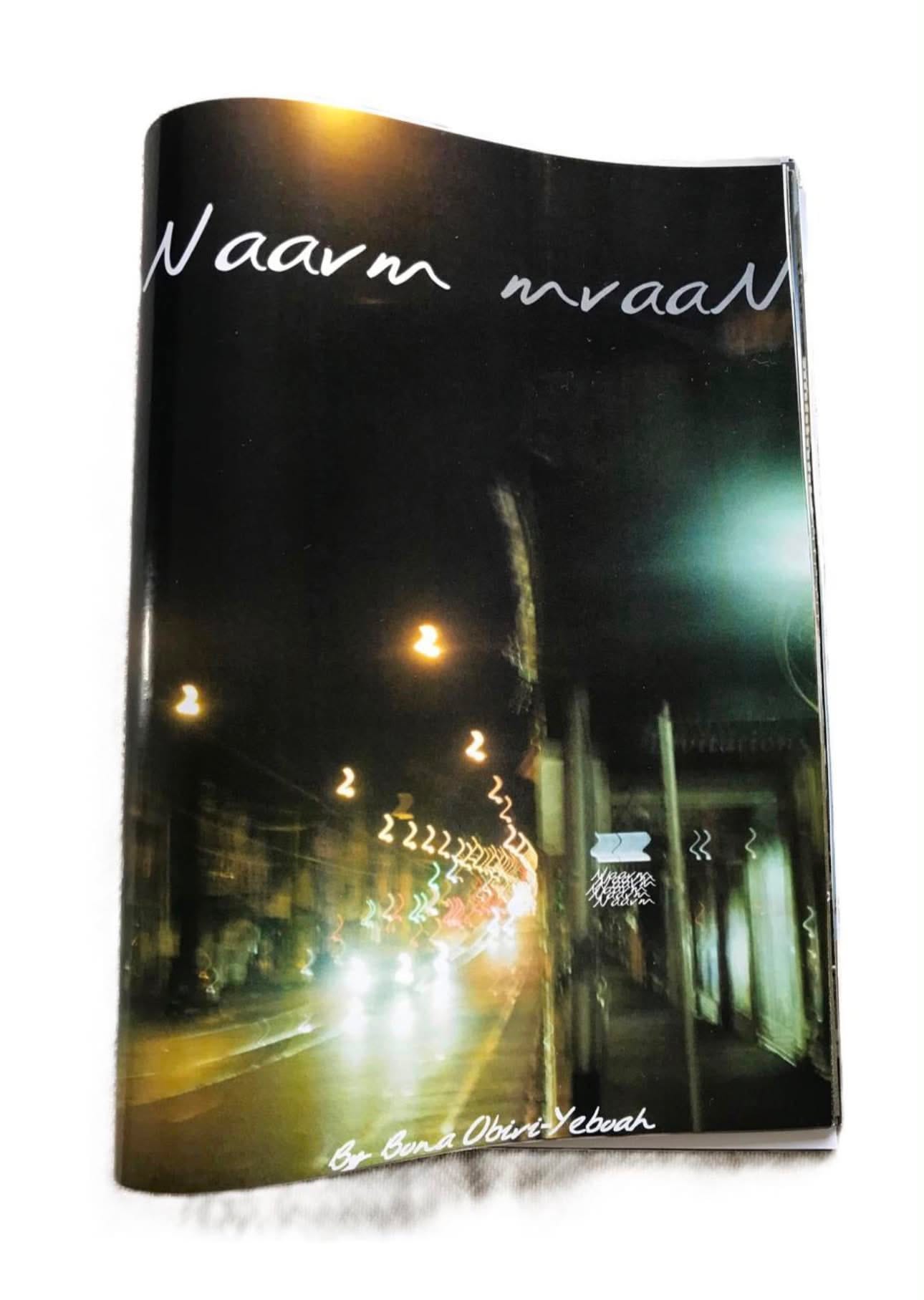
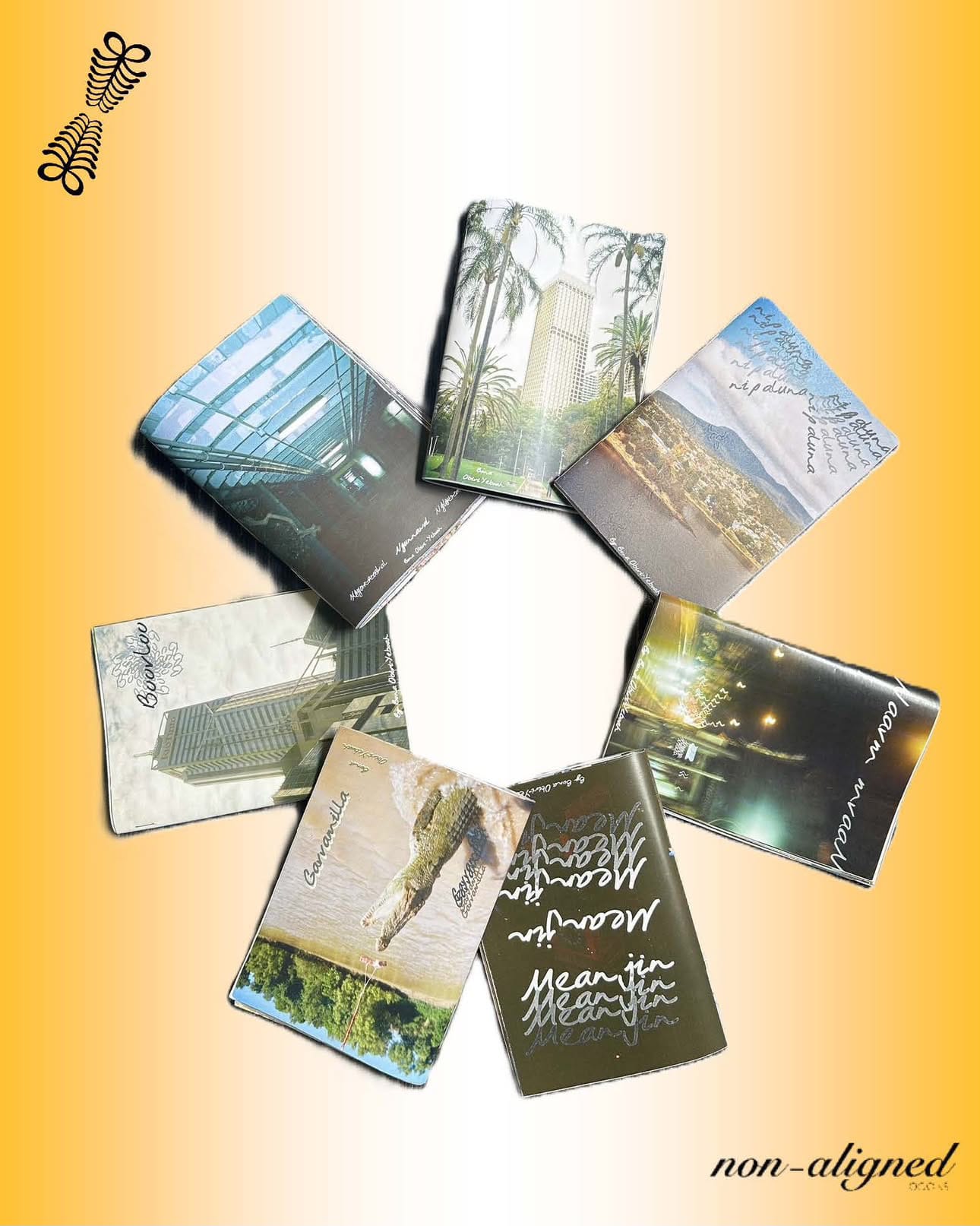
Australia, from an ongoing zine project.
It felt like my work finally had the right audience.
Now feeling that I had the right audience to receive my work, I began the slow process of cultivating relationships with people at book/zine fairs, and volunteers at library portal in Northcote.⁶ I collect the majority of publications from library portal, but also many from second-hand bookstores, eBay, donations, the Melbourne Art Book Fair, Sticky Institute⁷ zine fairs and other fairs to come.
I also invited long-time friends to share their printed matter with Non-Aligned Books, as many bookstores are competitive to stock publications in and also have high consignment fees that excludes emerging artists or just everyday people who like writing or making art from stocking their work.
One particular encounter that I would like to speak to is when I met Nia and Pras who are the co-owners of TOS! Kecil,⁸ an art bookstore in Yogyakarta. I met Nia first, at Press Print Party Art Book Fair in Jakarta (2025) and later, Pras in Jogja, when I donated copies of my so-called “Australia” zines to their in-store library.
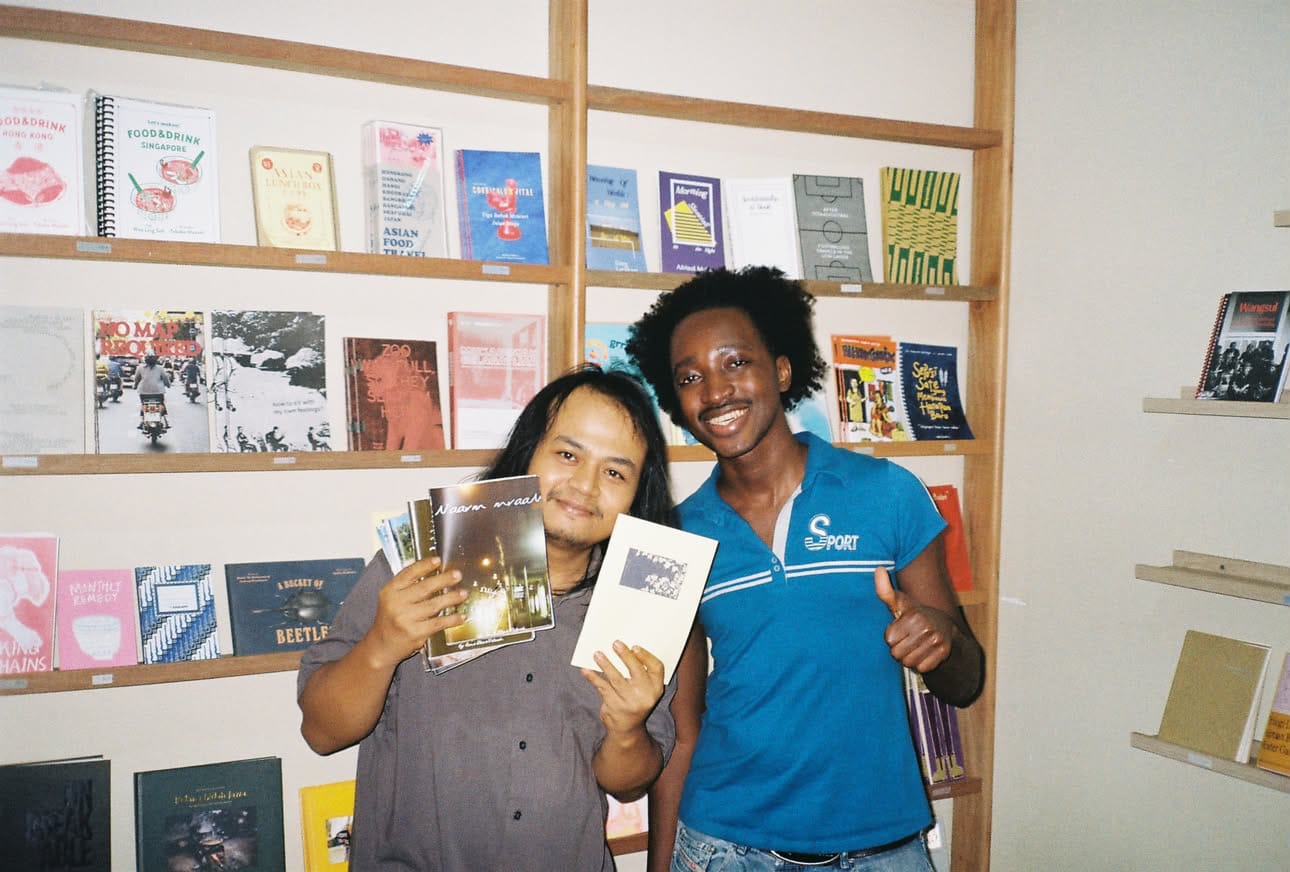
Meeting Nia and Pras gave me a strong foundation and confidence that I could open my own bookstore back home.
They shared many tips on the difference between consignment and wholesale, acquiring books at art book fairs to avoid shipping costs, the effect of cover-facing shelves compared to spine-facing shelves, lighting choices and being very specific and consistent in the kinds of books they curate for the store. At the end of my many conversations with Pras and Nia, I am always reminded and motivated by their tirelessness, righteousness and openness in running TOS! Kecil.
While my journey as a bookstore curator has roots in my formative years, it has continued by cultivating relationships with people in a meaningful, nurturing and mutually beneficial way. I have a strong interest in South-South co-operation, that is, where countries in the Global South co-operate without a Western country or corporation present. This interest and ongoing study of South-South co-operation manifests itself in my interest in anti-colonial thought and cultural critique.
While I live in the Global North, I still largely identify with the Global South. My hope for Non-Aligned Books is that we can continue to invoke the history of Afro-Asian solidarity and broader South-South co-operation in a real, physical and ongoing way.
Q4. You've organised and attended many workshops and community events this year, and we noticed a particular interest in zines. What do you think makes zines such a powerful format today? Do you see zine-making continuing to play an important role in your future publishing projects?
Bona:Zines are a powerful format because unlike a book, which requires more time, money, labour and commitment, anyone can make a zine and can make it by themselves. Zines make publishing democratic; by their very nature, zines are designed to be made and shared quickly, without oversight or a litany of contributors.
This is unlike a magazine, from which zine takes its name,¹⁰ which typically requires a long and involved publication process. Thinking about how zines by their name and nature have sought to reform and challenge established modes of printing production is incredibly important for the publishing world and also Non-Aligned Books’ future publishing projects.
There are many stories, concepts and histories that are seen as too “radical”, “provocative” or “sensitive” to be published by mainstream publishers or in dominant formats, such as the book or magazine.
Who gets to tell the story, how the story is told and how it is distributed are all highly monitored and controlled by the publishing industry as it exists today and as it is classically understood. As an independent bookstore, we are also not aligned to the interests of large corporate publishers or the State.
We want to make printed matter that appeals to conscious and underrepresented people in this colony, not whatever will appeal to the widest audience, will turn the most profit or advance the interests of Australia as a settler-colony.
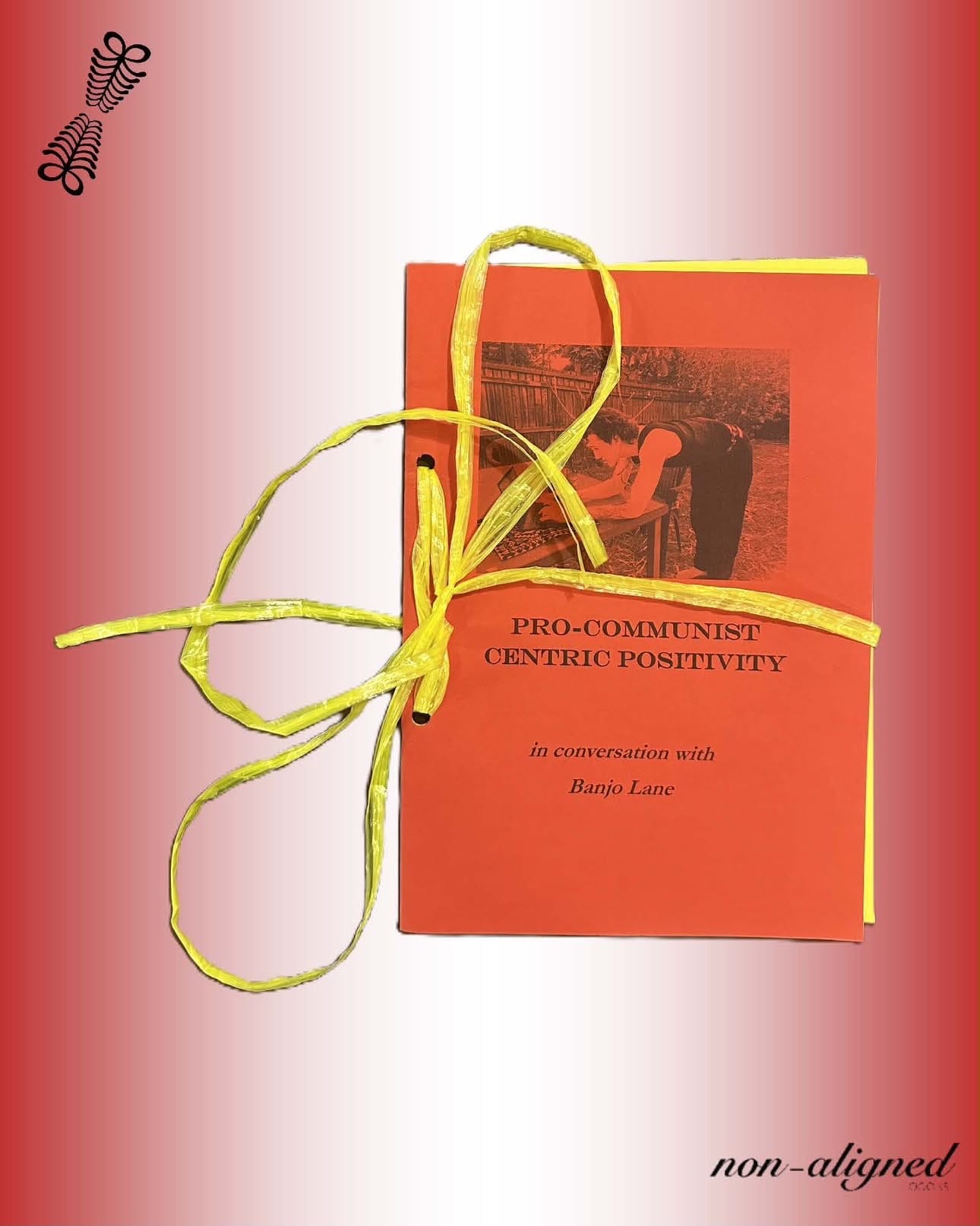
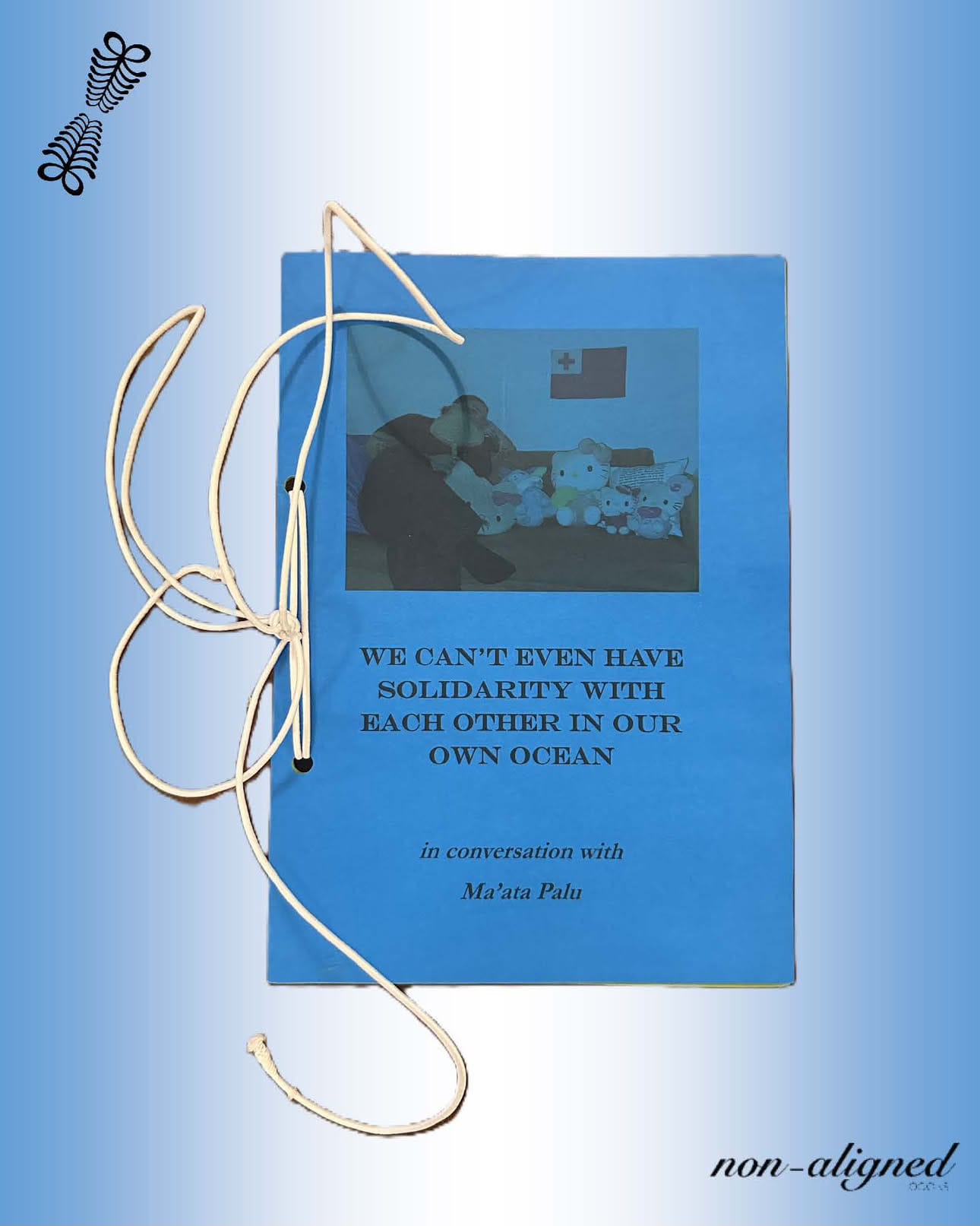
Interview zines published by Non-Aligned Books.
Zines help us realise these objectives, and we hope you can realise them with us too.
Home: A Place Yet To Be Settled
Part 3: Q5~Q7
Q5. You are not only a poet, but also the author of a newsletter with a growing readership. In almost every article, you write about music, writing, sound art, publishing, and the different practices that shape your life. What do these practices mean to you and what connects these different practices for you?
Bona:I have always been interested in bringing together various, and seemingly unrelated ways of knowing and being into the world. I first heard this phrase by bell hooks in her interview on the program, Speaking Freely, which first aired in 2002.⁹ Music, writing, sound art, publishing and interviews (like bell hooks’) are all different expressions via different mediums of the same idea: to transform reflection and observation into art.
Art is broadly defined as a diverse range of human creations and acts that express skill, imagination or emotional power. Art to me is harnessing technique with (usually) the intended outcome of moving people emotionally and psychologically. I think that drawing together these different ways of knowing and existing - music, writing, sound art, allows me to harness the different techniques of each medium to see the emotional power within them. Hopefully, in the process I can translate the power of each medium into publishing works that are impactful.
Q6. Many aspects of Non-Aligned Books seem closely tied to your personal history, birthplace (hometown), and cultural background. What do you think about the relationship between identity, memory, and place?
Bona:I always try to approach everything I do and every interaction I have in a deeply personal and specific way. My auntie (on my mother’s side) who lives in Washington D.C. describes me as a very principled person. I am unwavering and stubborn from my principles, so I think she is right.
Being born in Accra¹¹ at the turn of the millennium to parents working very hard in Amasaman and being brought to “Australia” for better opportunities has brought me to where I am today. I continue to invoke this and other personal histories to make sure I remember where I come from, but also to guide and inform my present and future.
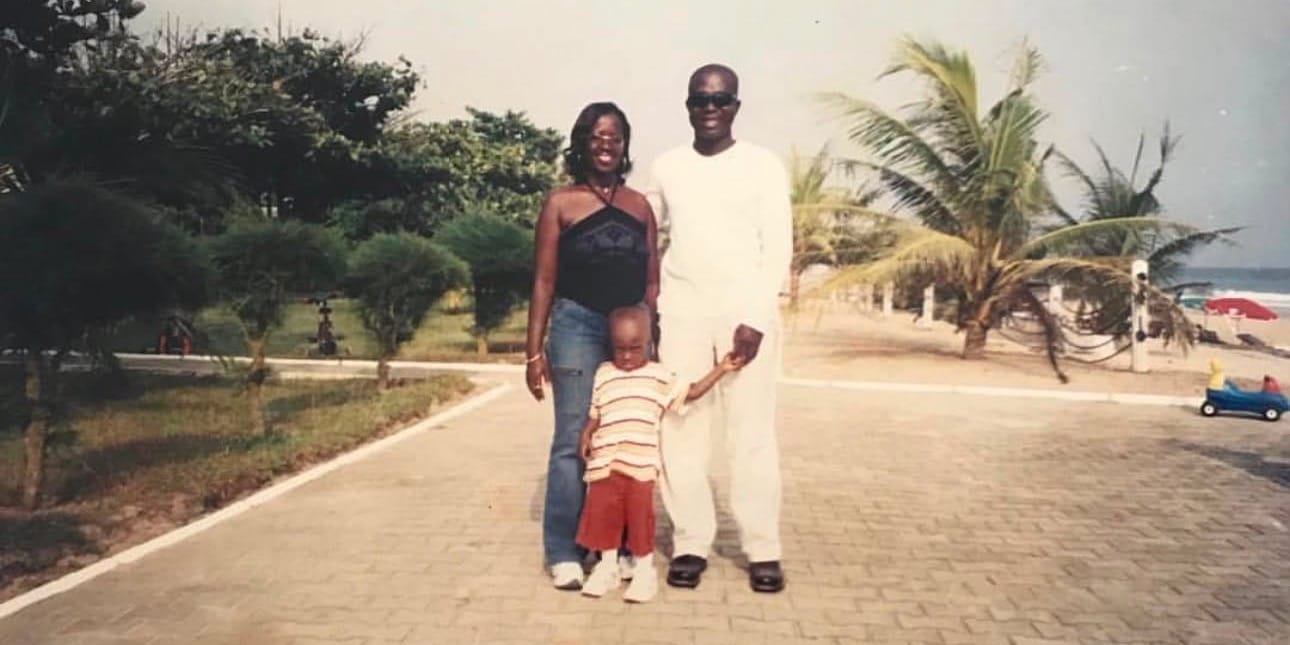
Without history…what do we have? The relationship between identity, memory and place are all intertwined for me. I see all three as equally important to feel grounded in a world where cultures, languages and peoples have been driven to extinction or are being actively erased.
I think this is a good time to also give some background on the logo of Non-Aligned Books. Our logo was designed in collaboration with Azul Bermudez, a graphic designer currently based in Mexico City, and a co-curator of N0 R3PLY Collective.¹² This collaboration is a further reflection of my interest and commitment to South-South co-operation, as mentioned previously.

More broadly, our logo underpins our publishing methodology. Our methodology is rooted in the traditions of storytelling by the Akan people of Ghana.
As founder and director of Non-Aligned Books, this design choice is a way of looking back to the continent for inspiration and direction. In doing so, we invoke the history, symbology and cultural language of our people.
Our logo “Aya” is a fern that comes from the Adinkra symbols of the Akan people of Ghana. It symbolises the ability to thrive and overcome hardship. It also represents independence and can be interpreted to mean ‘I am not afraid of you because I wear this [Aya] as a charm or amulet,’ or simply, ‘I am independent’.
By using this specific Adinkra symbol, it is a way of embedding independence from outside interests and influence into everything Non-Aligned Books does. Our hope is for Non-Aligned Books to be sovereign in its curation, to self-determine our destiny and to act in a way that while imperfect, strives to be principled, accountable and just.
Q7. Additionally, do you believe that the past remains embedded within us throughout our lives? Does it need to be transformed in order for us to move forward? And when you think about your hometown and your own history, do you feel optimistic about their place in your future?
I think that the past lives with us everywhere we go. Many cultures around the world with no prior contact with each other have experiences with or have concepts of ghosts amongst them. In many ways, I feel that history is a ghost.
Bona:It haunts us until we reckon with it, or until we address and lay to rest the situation or body from which the soul that haunts us came. History is a ghost we all have, and many of us have not reckoned with it.
To move forward I don’t think history needs to or can be transformed. It simply lives in and is trapped in that historical moment. To move forward we need to accept history as it is, in its fullest form, not an imagined history or a socially convenient history.
When I think about my hometown and my own history, I feel a small optimism about their place in my future. Although I was born in Ghana, I feel deeply estranged from it. Is this what Diaspora means? Throughout my time on Earth I have been navigating various forms of induced exile. Exile from my birthplace, my community and also from “normal” heterosexual life.
The state that Ghana is in socially and economically is turbulent. If I was to move back to Ghana tomorrow, I would struggle to be accepted into society because although I look like everyone else, the way I present, the way I speak and who I love is different to what is expected.
So I say small optimism because I think all humans have the propensity for change. I feel a strong bond to where I come from, but this bond is also riddled with questions and insecurities. I am confident in who I am and where I come from, but I do not know Ghana and she does not know me.
So it’s a conversation, maybe. Between myself and Ghana. It is a conversation long overdue, but one I am ready to have.
At Final...
Q8. In the photo, our postcard Is That You? can be seen pinned to your wall. What drew you to this postcard set when we met at the book fair?
Bona:I was drawn to the postcard Is That You? Because I liked the story behind you travelling to Europe by yourself(SOME GUEI_SOME JING). And Is That You? were photographs of hot boys that passed by Caspar's camera lens.¹³
It was great to see how Caspar framed each of the boys in his photographs so specifically, to draw out their natural beauty. Often, many of them are featured in a natural setting like next to the ocean or among trees and I thought this helped to re-inforce the role of beauty and nature in his work.
I also liked the title of Is That You? Because it made me wonder if I saw myself in any of these boys. Was I looking at versions of myself in these photos? Was it a delusion that any of these boys could have been or are like me? I don’t know. All I know is that in that moment when I interacted with the work at Press Print Party, these photos were like a mirror…and everytime I look at the photos I think to myself, “Is That You, Bona…?”
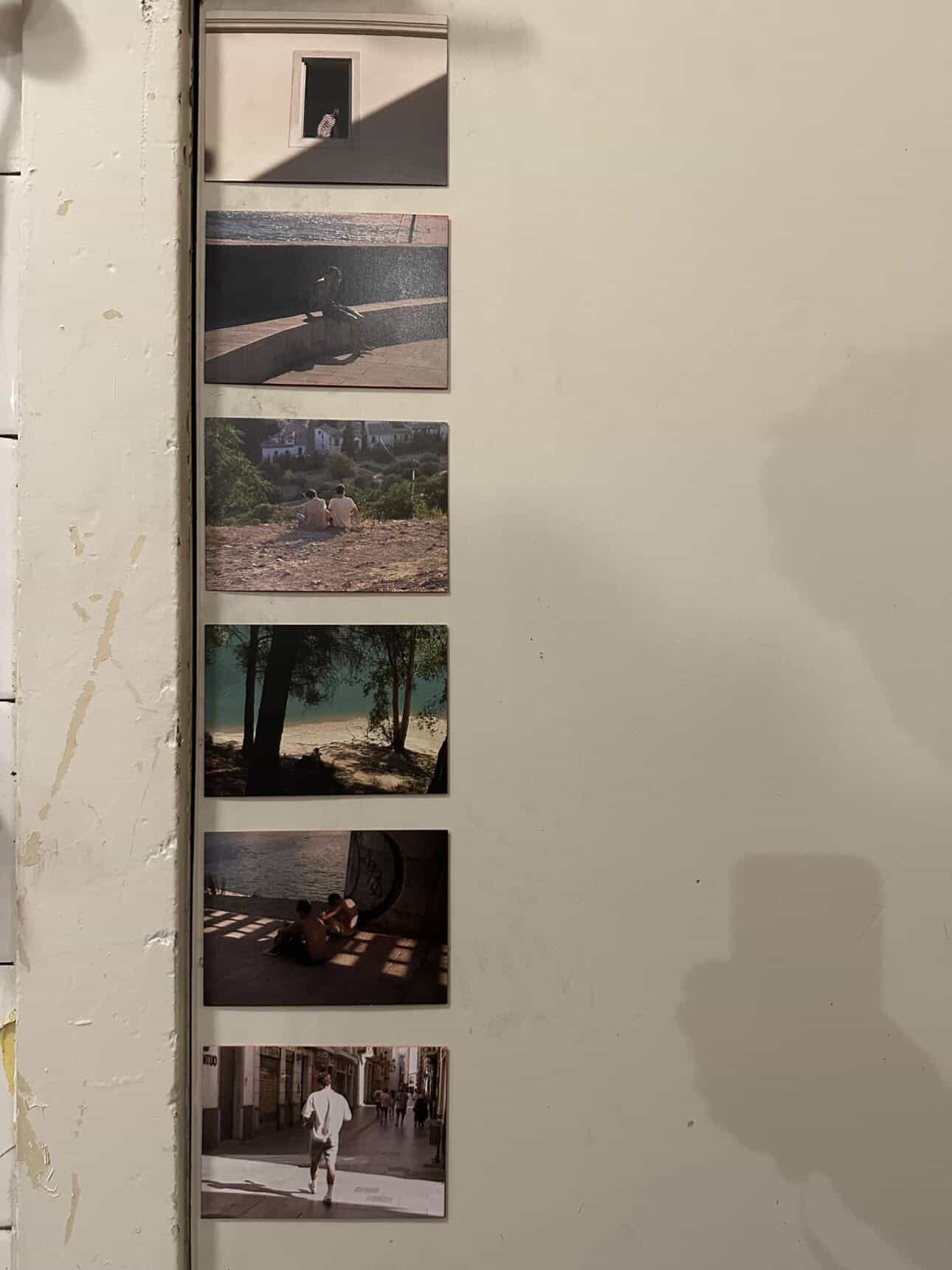
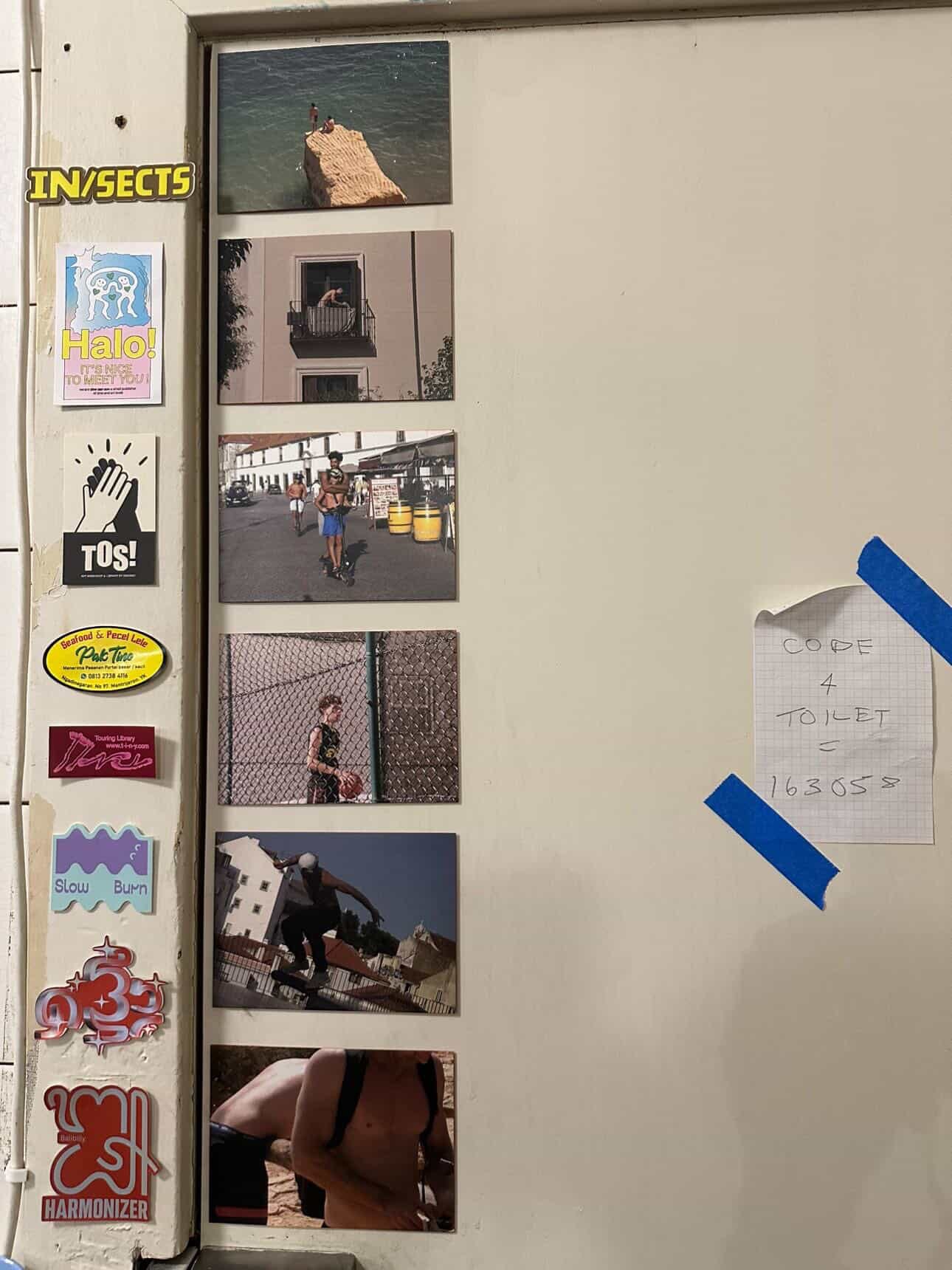
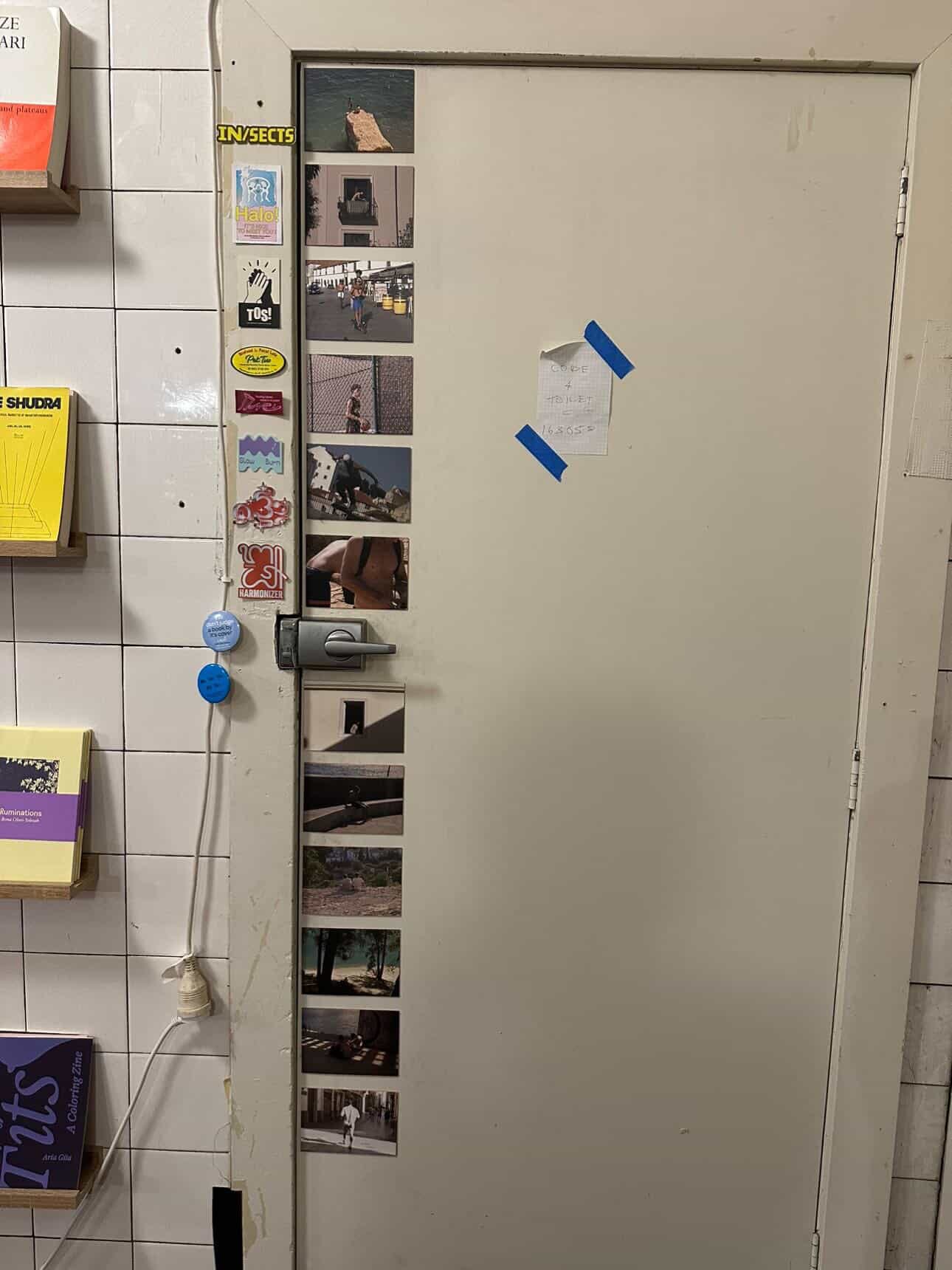
Is That You? displayed in a corner of Non-Aligned Books.
Thank you for making beautiful art, Caspar.
Q9. What can visitors expect from the launch of Non-Aligned Books, and is there anything you'd like to share with readers who may be visiting Melbourne and Non-Aligned Books in the near future?
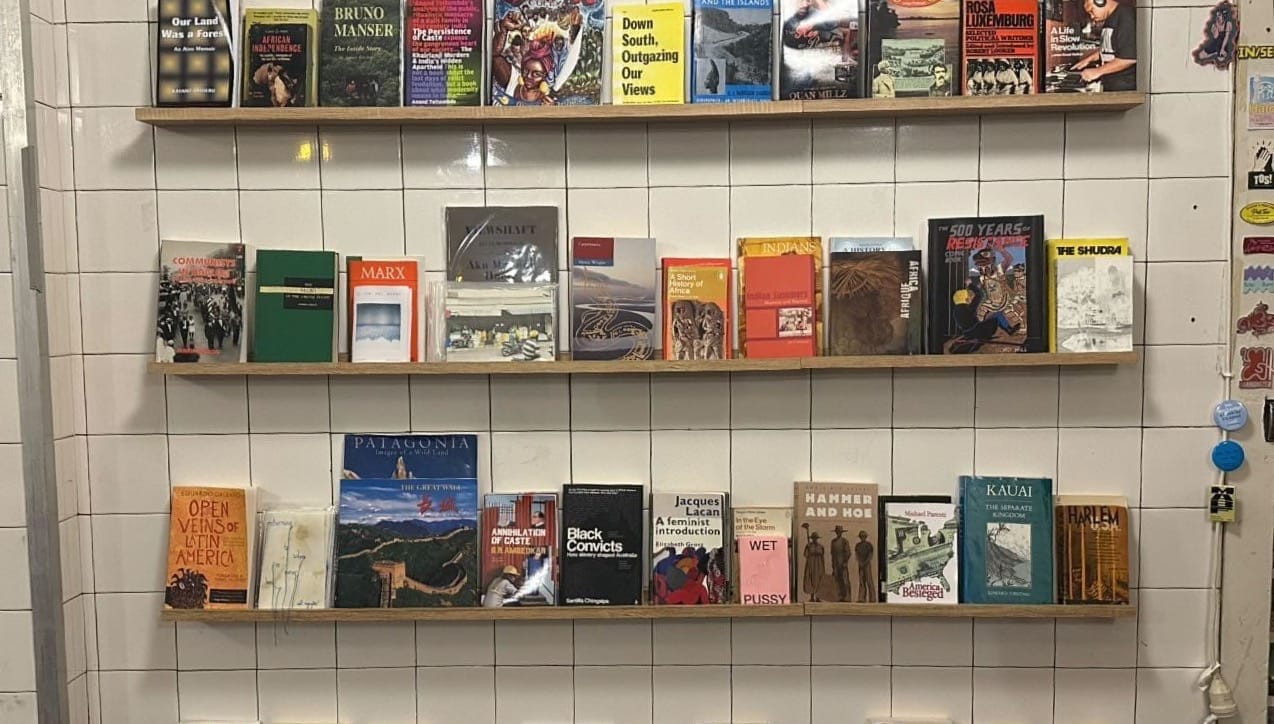
Bona:Visitors to Non-Aligned can expect a wide catalogue of books focusing on Africa and its Diaspora, but also on the Global South and how class struggle intersects with all of that. I’ve designed the space as a living room. A place for reflection, conversation and joy.
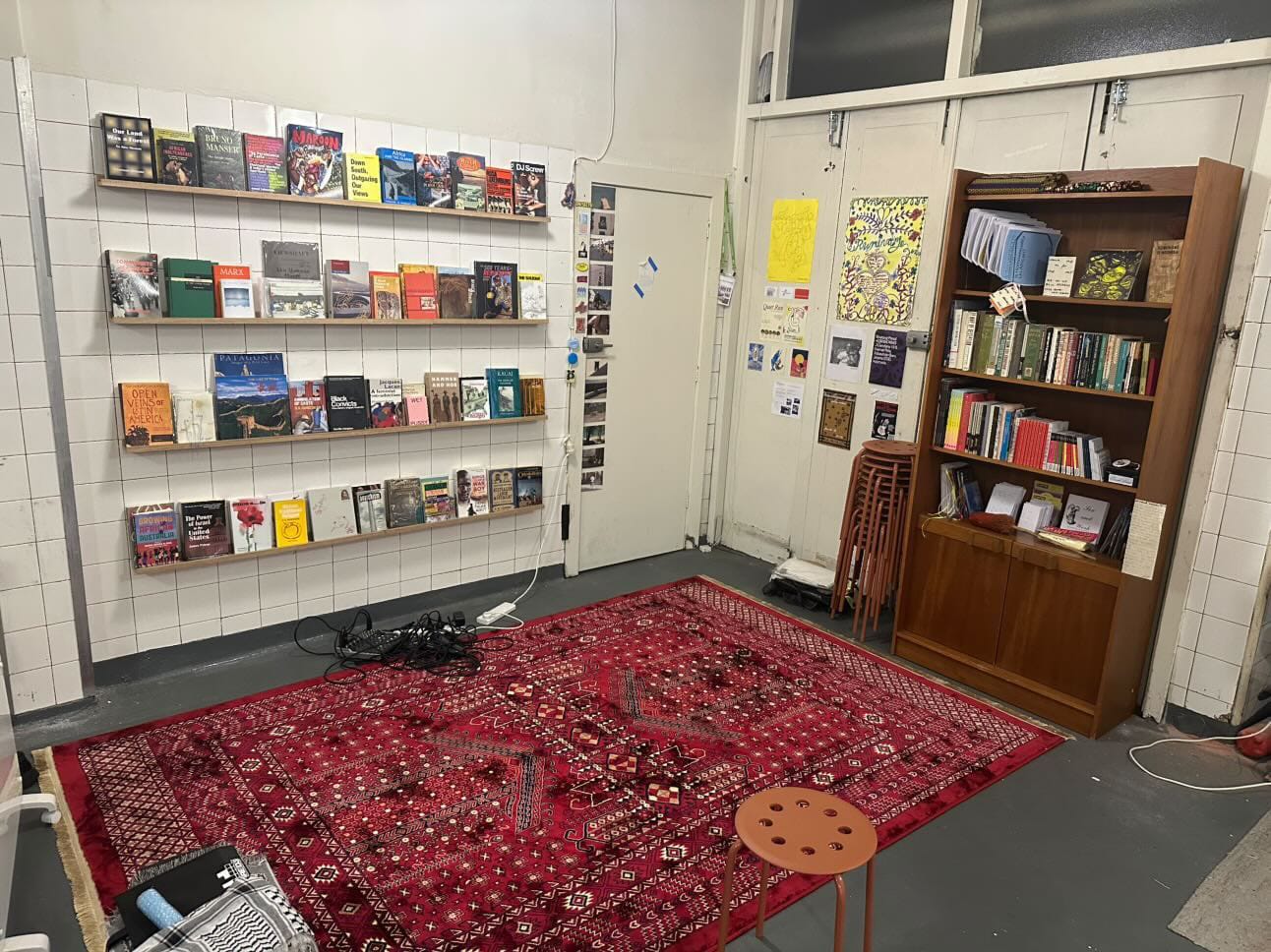
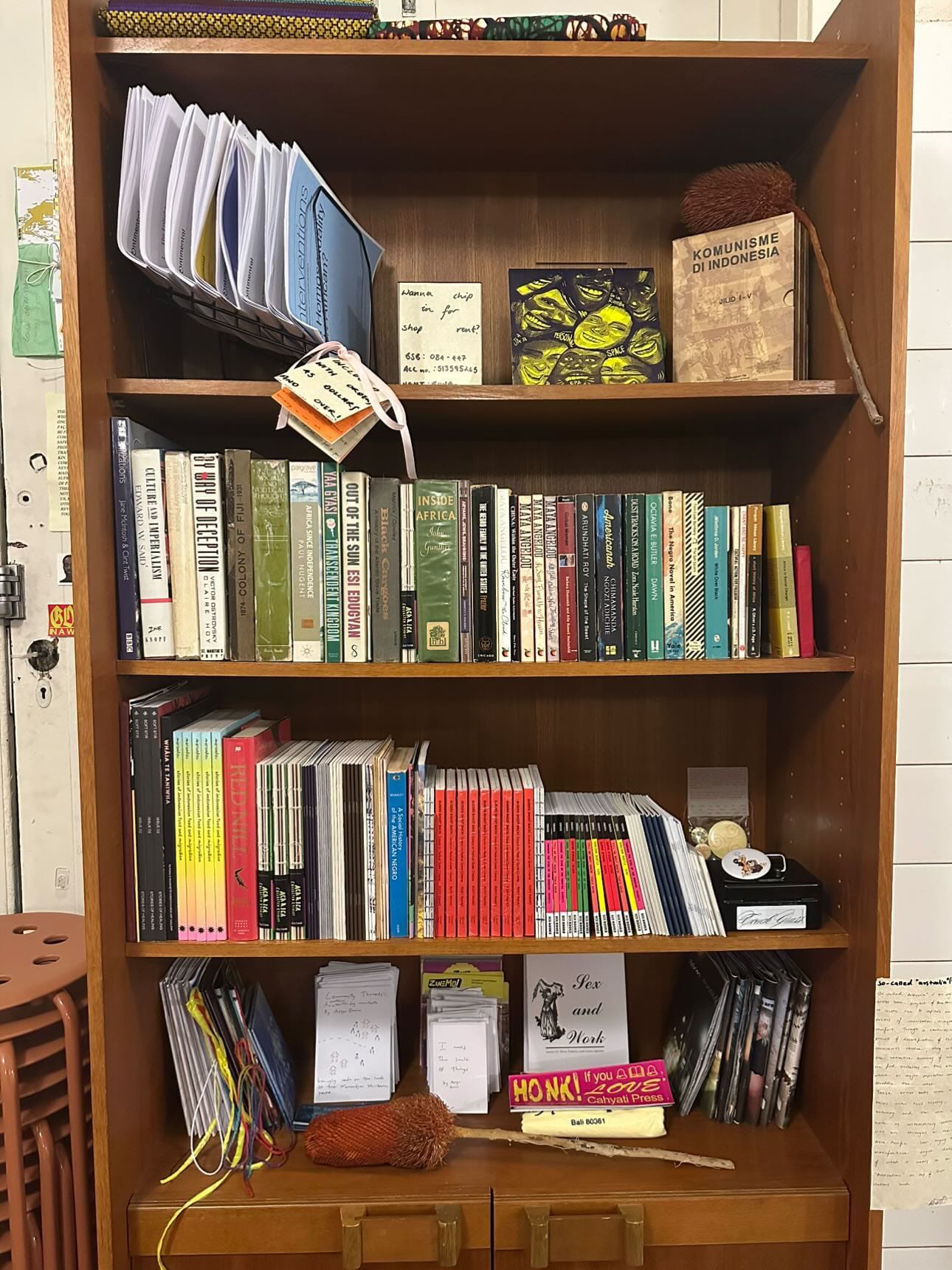
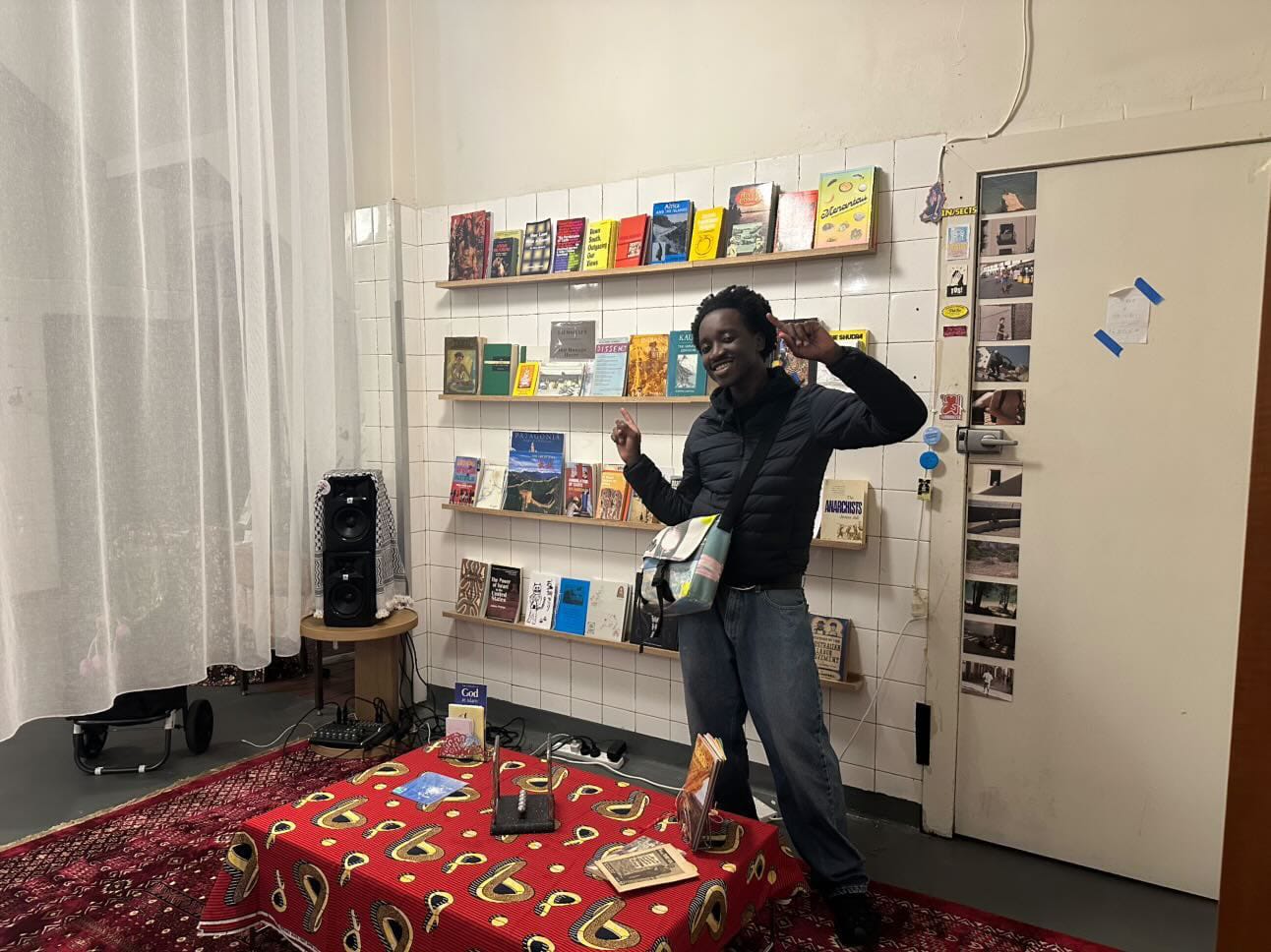
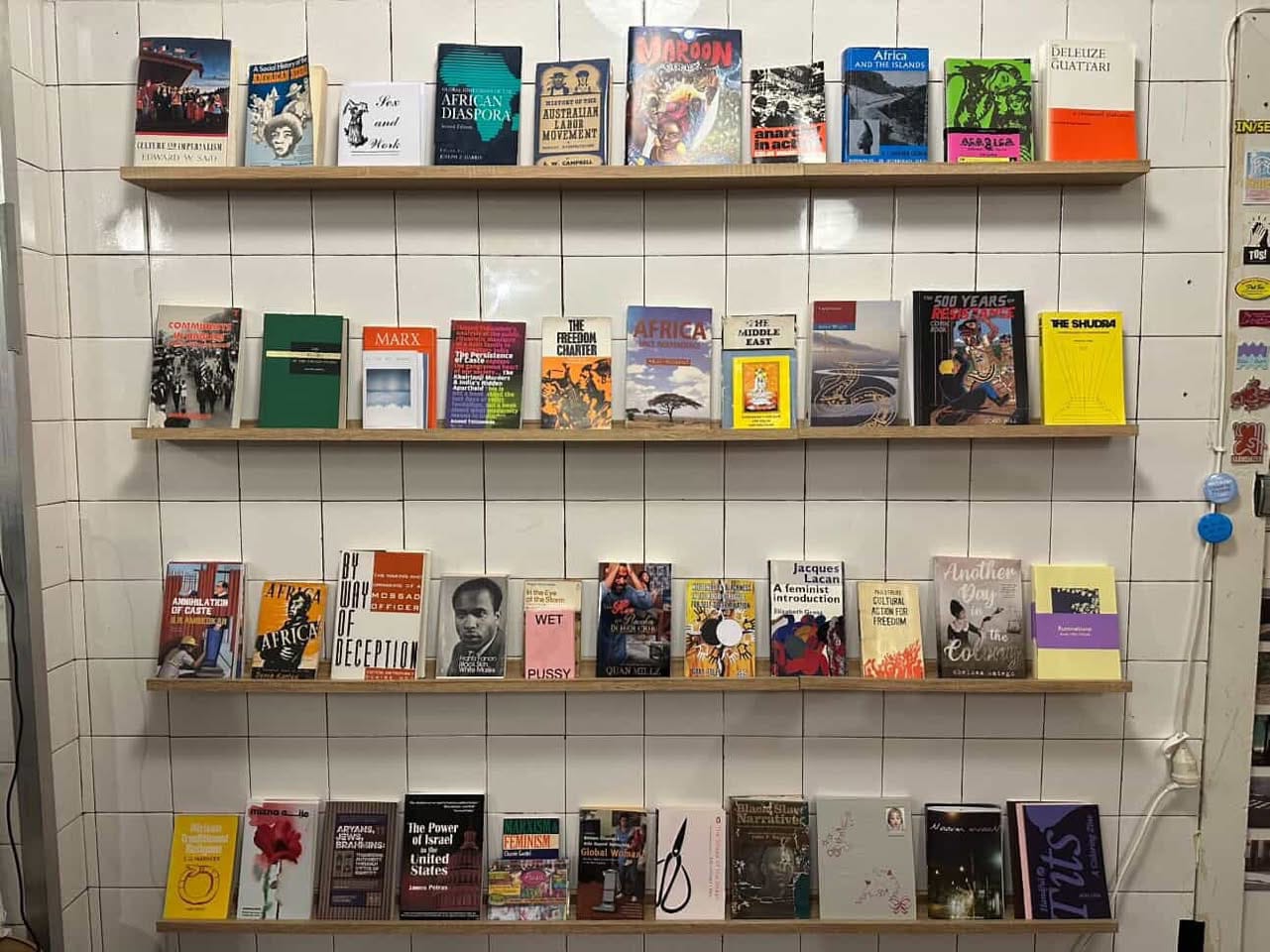
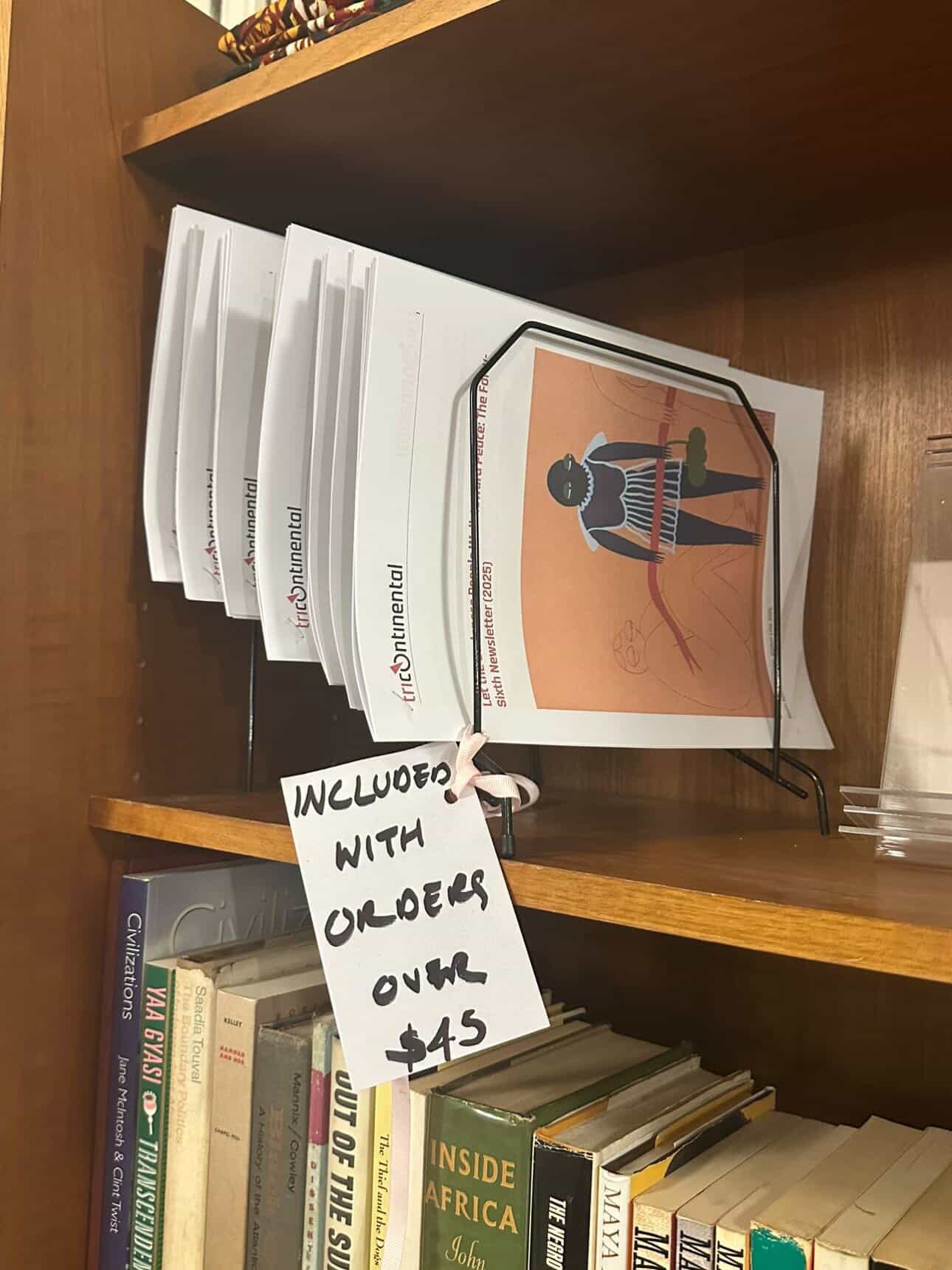
Inside Non-Aligned Books, 2026.
There are many places to sit, and visitors are encouraged to sit on the floor, where you will find a large rug from Afghanistan that brings our store together. When thinking about the set design based on other art bookstores and how I wanted the store to feel, it was important to me to reflect many of the living spaces in the Global South. These spaces make everyone equal, in that…no one is above another by sitting on chairs because people are pulled to sit on the ground. To be on the same level.
This is important because we want everyone to feel respected and to extend that respect in equal measure to others. We feel that this cannot be done if we operate on a hierarchy model. In not just our curation, but also store design we want concepts and people to be on the same level.
For the future, I would like to share with readers who may visit to be open-minded. The future is unknown, and we only have history to guide us. Come with respect, principle and an open heart and Non-Aligned Books will reciprocate that to you with both hands.
Q10. If authors from Taiwan were interested in distributing or consigning their publications through Non-Aligned Books, what kinds of projects would you be most excited to receive?
At the moment, we would be most interested to receive works that are simple, gentle and interrogative.
Non-Aligned Books is looking for work that brings these three ideas together: simplicity, gentleness and interrogation to distill them into a work with beauty.
Bona:Your publications can be fiction or non-fiction, real or fake, seen or unseen. It can span far back into ancient times or attempt to predict a future none of us have seen yet. What is most important though, is that the work is conscious and provokes conversation or an emotional response. We want to have an idea of how your work feels, not only looks or sounds. Include in your description the materials, binding methods and other techniques used to create your publication.
In addition to this, we are most excited and committed to works that speak to how Africa and Asia intersect. This can be historically, socially, economically or digitally. It is not a requirement for your work to speak to this to be accepted for consignment or distribution, but it is a core interest of ours, so it is something to keep in mind.
If you would like to submit your work to us, please send an email to us through nonalignedbooks@gmail.com and we would be happy to take a look. Thank you for inviting Non-Aligned Books for this interview Guei, it means a lot and is very special.
Yours in solidarity,
Bona
Closing with a playlist of Bona Obiri-Yeboah’s recent favourites.
Bona Obiri-Yeboah on Poetry, Diaspora, and Non-Aligned Books
Interview by Guei/to_ press
Photo credit by Bona Obiri-Yeboah
Notes
¹ Press Print Party, the city’s art book fair: Jakarta Art Book Fair was held from 2020 to 2023. Due to differences in direction and philosophy, Press Print Party branched off in 2024. There have been no further updates from the original Jakarta Art Book Fair.
² Cahyati Press: An independent publisher, bookshop, and printing studio founded in 2022 and based in Bali. It was co-founded by friends Syarafina Vidyadhana and Kat/Katyusha Methanisa, and currently operates between Bali and Meanjin/Brisbane. Its physical space is temporarily closed. Cahyati Press focuses on women, LGBTQIA+ creators, and experimental writers. Source
³ The bookstore’s closure statement posted on social media: The document/social media visual is presented in the format of a formal political communiqué. It opens with In the name of God, a phrase commonly used at the beginning of formal documents in Islamic contexts.
⁴ Global South: In contrast to the Global North, the term is not primarily geographical, but economic and political. According to Deutsche Welle and World Population Review, there are multiple interpretations of the Global South. Traditionally, it refers to less-developed or economically disadvantaged countries, many of which have histories of colonial rule by countries of the Global North, particularly European powers. It is generally understood to include Africa, Latin America and the Caribbean, Pacific Island nations, and developing countries in Asia. Source
⁵ Kunci, Zine Zan Zun, TOS! Kecil, Hyphen—, Graphic Handler, Cahyati Press, Binatang Press and more express their stories in print: These are referred to as “collectives” in English. This presentation provides a more detailed list of creative collectives in Indonesia.
⁶ Library Portal, Northcote: An independent library and community space in Northcote, in northern Naarm/Melbourne. Run by volunteers, it holds a collection of more than 10,000 books and hosts readings, music, art events, and workshops.
⁷ Sticky Institute: An artist-run initiative founded in Naarm/Melbourne in 2001, dedicated to the production, circulation, and promotion of zine culture. Alongside selling and consigning zines, it provides photocopiers, long-arm staplers, typewriters, and other facilities for makers, and organizes the major Australian zine event Festival of the Photocopier.
⁸ TOS! Kecil: An independent bookshop and publisher in Yogyakarta, Indonesia, focusing on artist books, zines, and independent publishing. It also serves as a space for local creators to meet and circulate publications.
⁹ bell hooks and Speaking Freely: In 2002, African American writer and cultural critic bell hooks was interviewed by Ken Paulson for the video program Speaking Freely, discussing freedom of speech, cultural criticism, education, race, gender, and love. “bell hooks” was her pen name, taken from the name of her maternal great-grandmother. She wrote it in lowercase to shift attention away from herself and toward her work, while also acknowledging her elder.
¹⁰ Magazine, from which zine takes its name: It also derives from fanzine (fan + magazine). The term “fanzine” was coined in 1940 by American science-fiction fan Russ Chauvenet, while related DIY self-publishing practices can be traced back to the 1930s.
¹¹ Accra, Ghana: The capital and one of the largest cities of Ghana, located on the Gulf of Guinea in West Africa.
¹² N0 R3PLY Collective: A creative collective operating between Naarm/Melbourne and Mexico City, formed by Azul Bermudez, Sen Vanderzalm, and Oti Lamana. Their practice spans exhibition design, curating, installation, and event production, with a focus on the intersections of design, contemporary art, music, and community-based practice.
¹³ Caspar: Freelance photographer and photographic artist Caspar Yeh, currently living and working in Taipei.
![從詩、離散到書店:Bona Obiri-Yeboah 與 Non-Aligned Books [中文翻譯版]](https://storage.ghost.io/c/a1/f8/a1f80857-5005-4565-bffa-6f05dce4d426/content/images/size/w600/2026/08/-------2026-08-08-------1.58.23-1.png)